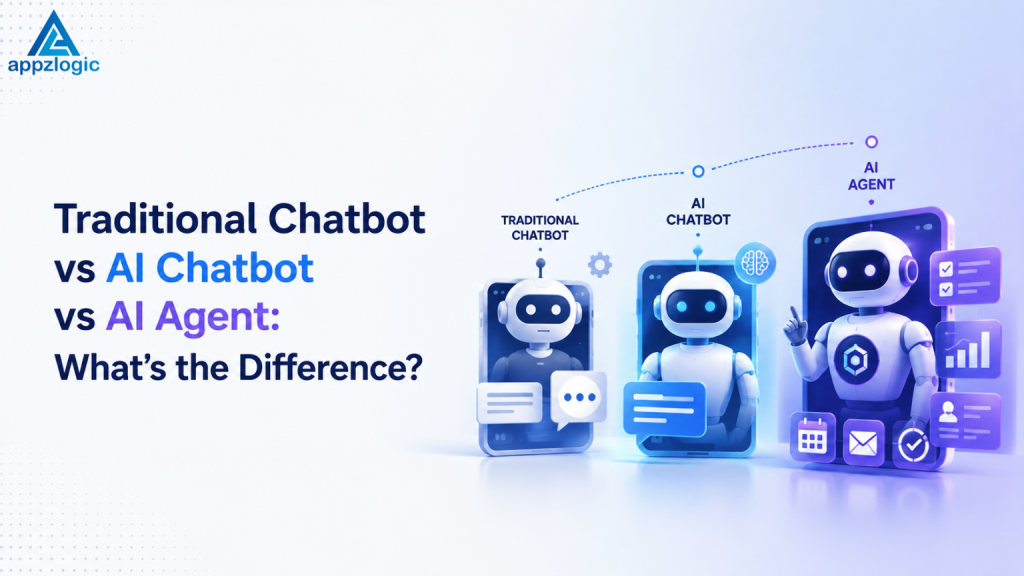
Traditional Chatbot vs AI Chatbot vs AI Agent: What’s the Difference?
Many businesses use AI-powered automation to enhance customer experience, reduce costs, and operate more efficiently. However, terms such as traditional chatbot, AI chatbot, and AI agent are often used interchangeably, making it hard for organizations to distinguish among them.
All three options help automate conversations and support users, but they differ in what they can do and how much they can help your business. We’ll break down the main differences between traditional chatbots, AI chatbots, and AI agents to help businesses choose the right AI automation solution.
What is a Traditional Chatbot?
A traditional chatbot follows set rules and responds to specific commands or scripts. It relies on decision trees, keywords, and fixed workflows.
These chatbots can only answer questions they have been programmed to handle.
For example:
- User: “What are your business hours?”
- Bot: “Our business hours are 9 AM to 6 PM.”
If a user asks something outside its script, the chatbot might not give the right answer.
Traditional chatbots have rule-based responses, recognize keywords, follow set workflows, have limited conversation skills, and do not understand context.
Their advantages include easy setup, low-cost basic support, and suitability for FAQs and simple tasks.
However, they cannot understand intent, do not learn over time, struggle with complex questions, and offer little personalization.
Traditional chatbots are best for businesses seeking simple customer service automation.
What is an AI Chatbot?
An AI chatbot is a more advanced system that uses artificial intelligence, natural language processing (NLP), and machine learning (ML) to engage in conversation with users.
Unlike traditional chatbots, AI chatbots can understand context, intent, and the flow of conversations. They offer more natural interactions and get better as they learn from experience.
For example:
- User: “I forgot my password and can’t log in.”
- AI Chatbot: “I can help you reset your password. Would you like me to send a reset link to your registered email?”
AI chatbots can recognize different ways people speak, handle spelling mistakes, and adapt to the tone of a conversation.
AI chatbots understand natural language, maintain context, recognize intent, handle multi-turn conversations, and learn and improve over time.
Their advantages are better customer experiences, more human-like conversations, handling complex questions, scalable support, and personalized support.
Limitations include the need for training data, higher setup costs, and, sometimes, the need for human assistance with advanced tasks.
AI chatbot solutions are used in customer service, healthcare, banking, eCommerce, and SaaS platforms.
What is an AI Agent?
An AI agent is the most advanced type of enterprise AI automation. It can interact with users, take actions, make decisions, automate workflows, and connect to different systems on its own.
AI agents combine conversational AI with reasoning, memory, automation, and the ability to work with other systems.
For example:
- User: “Book a demo meeting for next Tuesday and send the details to my email.”
- AI Agent: Checks calendar availability, Schedules the meeting, Sends email confirmation, and Updates CRM automation
Unlike chatbots, AI agents can complete tasks on their own instead of just answering questions.
AI agents can make decisions independently, automate workflows, connect to APIs and CRMs, retain context, handle multi-step tasks, and process data in real time.
Their advantages include full automation, reduced manual work, faster business operations, more informed decision-making, and a highly personalized customer experience.
Limitations include complex setups, the need for strong data and system integration, and higher infrastructure costs.
AI agents for business automation are quickly becoming the future of smart business automation.
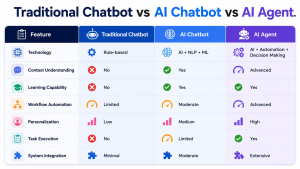
Which Solution Should Your Business Choose?
The best AI automation solution depends on your business goals, your customers’ expectations, and the complexity of your operations.
Choose a Traditional Chatbot If:
- You only need FAQ automation.
- Your workflows are simple.
- You have a limited budget.
- You require basic customer interaction.
Choose an AI Chatbot If:
- You want intelligent customer support.
- You need personalized interactions.
- You receive high volumes of customer queries.
- You want better engagement and faster resolutions.
Choose an AI Agent If:
- You want complete workflow automation.
- Your business relies on multiple software systems.
- You want AI-powered operational efficiency.
- You need autonomous task execution.
Industries Benefiting from AI Agents and AI Chatbots
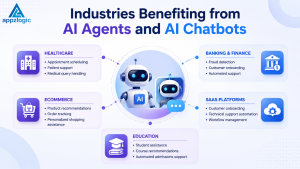
- Healthcare—Appointment scheduling, Patient support, and Medical query handling
- Banking & Finance—Fraud detection, Customer onboarding, and automated support
- eCommerce– Product recommendations, Order tracking, and Personalized shopping assistance
- SaaS Platforms—Customer onboarding, Technical support automation, and workflow management
- Education—Student assistance, Course recommendations, and Automated admissions support
The Future of Conversational AI
- Switching from traditional chatbots to AI agents is a big step in digital transformation.
- Businesses now need smart systems that can understand users, make decisions, automate tasks, boost productivity, and deliver personalized experiences.
- AI agents are expected to be the next generation of enterprise automation, helping businesses work smarter, faster, and more efficiently.
Final Thoughts
Traditional chatbots helped businesses automate basic conversations. AI chatbots improved customer engagement with smarter interactions. Now, AI agents are changing industries by combining conversation, automation, and decision-making into a powerful system. The right solution depends on your business needs, growth plans, and your customers’ expectations. Businesses that invest in AI-powered automation now will have a strong advantage over competitors in the future. Contact us to create your own AI chatbot or AI agent solution for your business.
Frequently Asked Questions
A traditional chatbot works on predefined rules and scripted responses, while an AI chatbot uses Artificial Intelligence (AI), Natural Language Processing (NLP), and Machine Learning (ML) to understand user intent and provide more human-like conversations.
It depends on your business requirements. AI chatbots are ideal for intelligent customer support and engagement, while AI agents are best for complete workflow automation and autonomous task execution.
Yes. AI chatbots use machine learning algorithms to improve responses over time by analyzing customer interactions and conversation patterns.
AI chatbot implementation costs vary depending on features, integrations, and complexity. They generally cost more than traditional chatbots but provide better scalability and customer engagement.
The future of conversational AI lies in intelligent AI agents capable of autonomous decision-making, workflow automation, personalized interactions, and real-time business support.