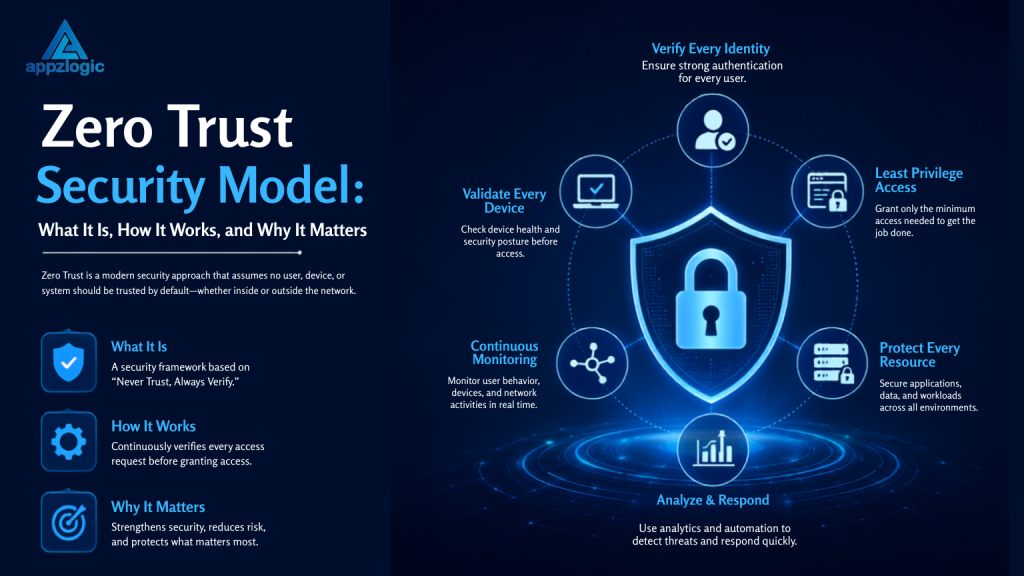
Zero Trust Security Model: What It Is, How It Works, and Why It Matters
Organizations now face more advanced cyber threats, remote work, cloud technology, and broader attack surfaces. Trusting only an internal network is no longer enough to protect important business assets.
That’s why the Zero Trust Security Model matters.
Zero Trust is a modern cybersecurity approach that assumes no user, device, application, or system is trusted by default, whether inside or outside the network. Each access request is checked before allowing access to resources.
What Is Zero Trust?
The Zero Trust security framework is based on the idea of “Never Trust, Always Verify.”
Unlike traditional security models that focus on the network perimeter, Zero Trust removes automatic trust and requires ongoing checks of users, devices, applications, and workloads before granting access.
The goal is to lower security risks, prevent unauthorized access, and limit damage from cyberattacks by using strict access controls and continuous monitoring.
Why Organizations Need Zero Trust
Modern enterprises face several cybersecurity challenges:
- Cybercriminals are increasingly using ransomware and phishing attacks to steal sensitive data, disrupt operations, and cause financial losses. Organizations need proactive security measures to detect and prevent these threats.
- With employees working from multiple locations and devices, the risk of unauthorized access and data exposure has increased. Securing remote users and endpoints is essential for maintaining business security.
- As businesses adopt cloud and multi-cloud environments, managing security across different platforms becomes more challenging. Consistent security controls are required to protect applications and data everywhere.
- Third-party vendors and partners often need access to business systems, creating additional entry points for attackers. Proper access management and continuous monitoring help reduce these risks.
- Misused credentials and insider activities can lead to unauthorized access to critical systems and sensitive information. Limiting access privileges and monitoring user behavior can help prevent security incidents.
- Organizations face increasing pressure to comply with data privacy, cybersecurity, and industry-specific regulations. A strong security framework helps ensure compliance while reducing operational and legal risks.
Zero Trust helps organizations address these challenges by focusing on security and protecting users, applications, and data wherever they are.
How Zero Trust Works
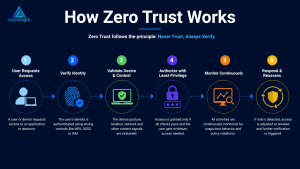
Zero Trust verifies every access request using multiple security controls before granting access.
1. Verify Identity
Every user must be authenticated using strong identity verification methods such as:
- Multi-Factor Authentication (MFA)
- Single Sign-On (SSO)
- Identity and Access Management (IAM)
- Biometric authentication
2. Validate Device Security
Devices are checked for security before they are allowed access.
Verification includes:
- Device health checks
- Endpoint security status
- Operating system updates
- Compliance policies
3. Enforce Least Privilege Access
Users get only the access they need to do their jobs.
This limits how far attackers can go and reduces the risk if an account is compromised.
4. Segment Networks and Resources
Micro-segmentation divides applications, systems, and workloads into smaller security zones.
This prevents attackers from moving easily through the network if a breach occurs.
5. Monitor and Analyze Continuously
User actions, device behavior, and network traffic are continuously monitored through analytics and AI-driven threat detection.
If something suspicious occurs, alerts are sent, and security responses are automatically triggered.
Core Components of a Zero Trust Security Model
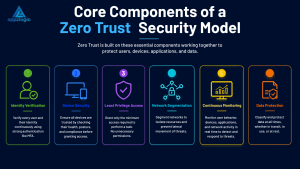
- Identity and Access Management (IAM) ensures that only authorized users can access systems and resources through strong authentication and authorization controls.
- Multi-Factor Authentication (MFA) adds an additional layer of security beyond passwords by requiring multiple verification methods.
- Device Security validates endpoint security posture before granting access to applications and data.
- Network Segmentation separates critical assets and workloads into secure zones to limit unauthorized movement.
- Data Protection protects sensitive information using encryption, data classification, and access controls.
- Security Analytics and Monitoring provides real-time visibility into user behavior, system activities, and potential threats.
- Policy Enforcement applies security policies consistently across users, devices, applications, and workloads.
Key Capabilities of Zero Trust
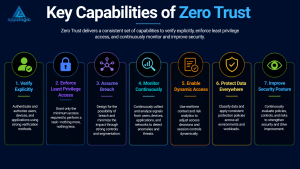
1. Continuous Verification
Every access request is checked and verified, no matter where the user is.
2. Context-Aware Access
Access decisions are based on multiple factors, including:
- User identity
- Device status
- Location
- Risk level
- Application sensitivity
3. Least Privilege Enforcement
Users only access the resources necessary for their responsibilities.
4. Micro-Segmentation
Limits the spread of threats across networks and applications.
5. Real-Time Threat Detection
It detects suspicious behavior and security issues before they become bigger problems.
6. Automated Security Response
This allows quick action to contain and fix security incidents.
Benefits of Implementing Zero Trust
- It reduces the risk of unauthorized access, compromised accounts, and cyberattacks by always checking and using strong security controls.
- It limits user actions and monitors activity to help prevent insider threats and unauthorized actions.
- It reduces the attack surface by blocking unnecessary access and limiting attackers’ opportunities to find weaknesses.
- It protects important business and customer data, whether on-premises, in the cloud, or in a hybrid environment.
- Helps organizations meet regulatory and industry compliance requirements, including GDPR, HIPAA, PCI DSS, ISO 27001, and NIST frameworks.
- It enables employees to securely access applications, systems, and data from any location without compromising security.
- It provides greater visibility into users, devices, applications, and network activities, helping security teams identify and respond to threats faster.
Common Challenges in Zero Trust Adoption
Organizations can face several challenges when implementing Zero Trust:
- Legacy infrastructure limitations: Older systems may not integrate with modern Zero Trust security controls.
- Complex application environments: Managing security across many applications, platforms, and environments can be difficult.
- Lack of visibility across systems: Limited insight into users, devices, and network activity makes it harder to detect threats.
- User experience concerns: Extra security steps can affect user convenience if not implemented well.
- Resource and skill shortages: Some organizations may lack the cybersecurity expertise needed to design and manage Zero Trust projects.
- Integration complexity: Connecting Zero Trust technologies with current systems and workflows often needs careful planning and execution.
A well-planned Zero Trust strategy can help overcome these challenges and keep your business running smoothly.
Implementing Zero Trust with Appzlogic
We help organizations design, implement, and improve Zero Trust security frameworks that fit their business needs and compliance goals.
Our Zero Trust implementation services include:
- Security Risk Assessment Services: We review your current security setup, identify risks, and create a custom Zero Trust plan.
- Identity and Access Modernization: We implement advanced IAM, MFA, SSO, and privileged access management solutions.
- Network and Application Segmentation: Our experts design secure architectures that limit unauthorized access and reduce the attack surface.
- Endpoint Security Integration: We strengthen device security through continuous monitoring, endpoint protection, and compliance enforcement.
- Cloud Security Services: We secure cloud environments, SaaS applications, and hybrid setups using Zero Trust principles.
- Security Monitoring and Threat Detection: We use advanced monitoring, analytics, and automated responses to proactively manage threats.
- Compliance Alignment: We help organizations match their Zero Trust efforts with industry regulations and security standards.
Why Choose Appzlogic?
Appzlogic Zero Trust security solution helps organizations to protect users, applications, and data across cloud, on-premises, and hybrid environments.
Our cybersecurity consulting services combine industry best practices, advanced security technologies, and compliance-driven strategies to strengthen your overall security risk assessment.
Conclusion
Cyber threats are always changing, so traditional perimeter-based security no longer protects modern businesses. Zero Trust offers a proactive way to secure users, devices, applications, and data by continuously verifying access and applying least-privilege principles.
By adopting Zero Trust implementation services, organizations can improve security, meet compliance requirements, reduce risk, and support secure digital transformation.
Frequently Asked Questions
The core principle of Zero Trust is "Never Trust, Always Verify," requiring continuous authentication and authorization for every access request.
No. Organizations of all sizes can benefit from Zero Trust by improving security and reducing cyber risks.
No. Zero Trust complements firewalls and other security controls by adding identity-based and context-aware access protection.
MFA, IAM, SSO, endpoint security, network segmentation, encryption, security analytics, and continuous monitoring are commonly used.
Implementation timelines vary based on organizational size, infrastructure complexity, and security requirements, but most organizations adopt Zero Trust in phases.