Application Security: Safeguarding Web & Mobile Applications in the Digital Era
Today, businesses rely on web and mobile apps. Securing these platforms helps protect data, keep user trust, and stop cyber threats.
Why Application Security Matters
Cyber attackers target web and mobile platforms because they are easy to access and store large amounts of data. Weak security can lead to data breaches, identity theft, financial losses, reputational damage, and legal trouble.
It’s important to define application security to understand how it protects software.
Application security means identifying weaknesses, implementing protections, and continuously monitoring threats throughout the software’s lifecycle.
Knowing about web application security helps address the unique threats found online.
Web application security protects apps that run in browsers and servers from cyber threats.
Common Web Application Threats
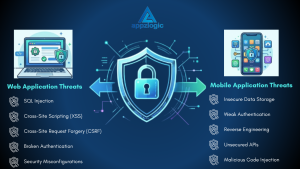
- SQL Injection occurs when attackers manipulate database queries to gain unauthorized access to sensitive data.
- Cross-Site Scripting (XSS) involves injecting malicious scripts into web pages, which are then executed in users’ browsers.
- Cross-Site Request Forgery (CSRF) tricks users into performing unauthorized actions on a web application without their consent.
- Broken authentication happens when weak login or session management systems are exploited by attackers to gain unauthorized access.
- Security misconfigurations arise when improper server or application settings expose systems to potential vulnerabilities.
Best Practices for Web Security
- Use HTTPS to secure communication protocols.
- Implementation of Web Application Firewalls (WAF)
- Validating and sanitizing all user inputs.
- Follow OWASP Top 10 guidelines.
- Scan for vulnerabilities and conduct regular penetration testing.
- Securing the APIs and backend services
Learning about mobile application security is important for keeping smartphone and tablet apps safe.
Mobile application security keeps apps on smartphones and tablets safe from threats to devices, networks, and users.
Common Mobile App Threats
- Insecure data storage occurs when sensitive data is stored without proper encryption, making it vulnerable to unauthorized access.
- Weak authentication arises from poor login mechanisms or session management, allowing attackers to easily gain access.
- Reverse engineering involves attackers decompiling applications to analyze the code and identify vulnerabilities.
- Unsecured APIs can lead to data leaks when backend services are not properly protected.
- Malicious code injection happens when attackers insert harmful code into an application, compromising its functionality and security.
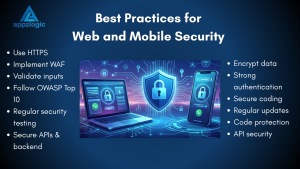
Best Practices for Mobile Security
- Encrypt data at rest and in transit
- Implement strong authentication (MFA, biometrics)
- Use secure coding practices.
- Update and patch applications regularly.
- Protect against reverse engineering (code obfuscation)
- Secure APIs using authentication and rate limiting.
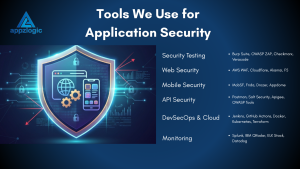
Tools We Use for Application Security
We use top security tools to protect web and mobile apps at every stage of development.
- Security Testing Tools – Burp Suite scans web applications for vulnerabilities and is used in penetration testing to identify security flaws. OWASP ZAP automates security testing to quickly detect vulnerabilities in web applications. Checkmarx analyzes source code (SAST) during development to identify security issues early. Veracode provides a platform for continuous application of security testing and risk management throughout the software lifecycle.
- Web Security Tools – AWS WAF protects web applications against common exploits and malicious traffic. Cloudflare offers DDoS protection and web application firewall features to block threats. Akamai delivers web security services and optimizes website performance. F5 analyzes network traffic to detect threats and provides advanced application protection.
- Mobile Security Tools – MobSF (Mobile Security Framework) automates testing security vulnerabilities in mobile applications. Frida is a dynamic analysis tool used to test the security of mobile apps at runtime. Drozer analyzes Android applications to discover security risks and vulnerabilities. Appdome automates and enhances mobile app security apps with additional protection features.
- API Security Tools – Postman is used to test and validate the security and functionality of API endpoints. Salt Security detects and prevents threats targeting APIs. Apigee manages and monitors APIs to ensure secure use. OWASP tools help identify and address API-specific vulnerabilities.
- DevSecOps & Cloud Security Tools – Jenkins and GitHub Actions integrate security checks into CI/CD pipelines for ongoing secure software delivery. Docker Security tools scan container images for vulnerabilities and threats. Kubernetes security tools control security for clusters and workloads. Terraform security tools monitor and enforce secure configurations in infrastructure-as-code.
- Monitoring & Threat Detection Tools – Splunk enables real-time monitoring and security analytics for applications and networks. IBM QRadar delivers threat intelligence and helps detect security incidents. ELK Stack (Elasticsearch, Logstash, Kibana) provides log analysis for security insights. Datadog provides cloud infrastructure monitoring and real-time threat detection.
Unified Security Approach (Web + Mobile)
Organizations use a unified strategy to get complete protection:
- DevSecOps Integration to Embed security in CI/CD pipelines
- Continuous Monitoring for Detecting threats in real time
- Identity & Access Management (IAM) controls user access.
- Security Testing for SAST, DAST, and penetration testing
- Cloud Security Integration to implement Secure cloud-hosted applications
Benefits of Strong Application Security
- Protects user and business data
- Builds customer trust
- Ensures compliance with global regulations
- Reduces risk of cyberattacks
- Enables secure digital transformation
The Future of Application Security
As AI, cloud computing, and mobile-first strategies grow, application security is moving toward the following:
- AI-driven threat detection
- Zero Trust architecture
- Automated security testing
- Cloud-native and API-first security
Conclusion
As businesses grow online, making application security a priority is crucial. Taking a proactive, integrated approach keeps apps secure, strong, and ready for future challenges.