AI Governance vs AI Security: What’s the Difference?
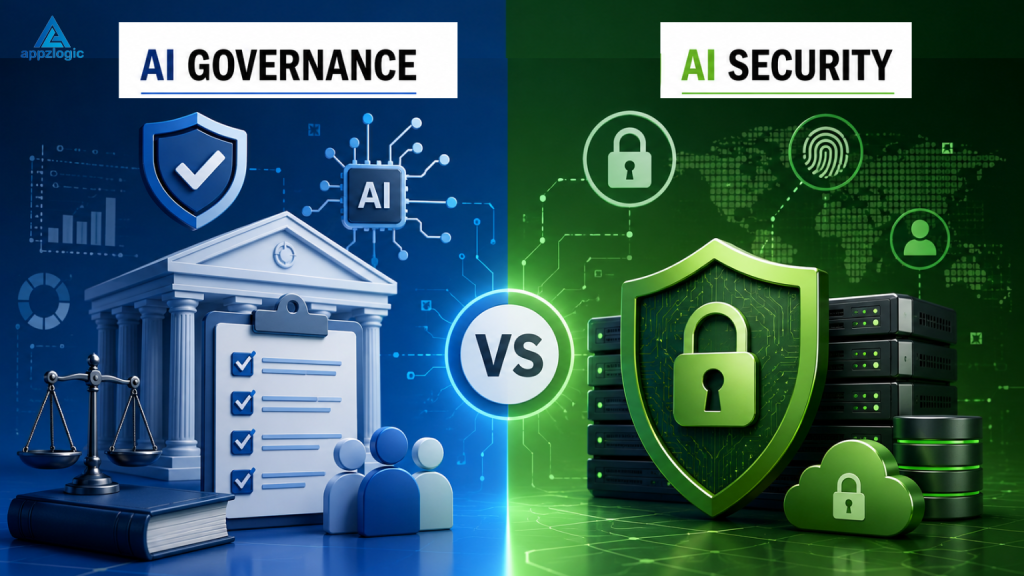
Artificial Intelligence (AI) has become an essential part of business operations. It helps companies automate work, make better decisions, improve customer service, and encourage innovation. As more organizations rely on AI, they face new challenges in managing and protecting these systems. Two key ideas for using AI well are AI Governance and AI Security. While they are related, each serves a different purpose. AI Governance ensures that AI is developed and used responsibly, ethically, and in accordance with regulations. AI Security protects AI systems, data, and infrastructure from cyber threats and attacks. Knowing the difference between AI Governance and AI Security helps organizations use AI safely and reduce risks.
What is AI Governance?
An AI Governance framework sets out the rules and steps for creating, using, and managing AI systems in a company. Its main goal is to ensure AI aligns with business goals, ethics, laws, and company values. As AI plays a bigger role in business decisions, companies need governance to support accountability, transparency, and trust. Without strong governance, AI can lead to bias, privacy issues, or hard-to-explain decisions.
Key Objectives of AI Governance
- AI systems should make fair and unbiased decisions that follow ethical standards. AI governance frameworks help companies find and reduce bias in data and algorithms.
- Governments around the world are creating new rules for AI. Governance helps companies comply with laws on data privacy, consumer protection, industry standards, and AI responsibility.
- Companies need to know how AI models make decisions. Governance encourages practices that make AI easier to explain, helping people trust the results.
- AI can bring new risks to operations, reputation, legal matters, and finances. Governance helps spot, assess, and reduce these risks before they cause problems.
- Clear ownership and oversight ensure that AI systems are continuously monitored and that responsibility is assigned when issues arise.
AI Governance depends on several important parts to help organizations manage AI responsibly. These include setting clear policies and standards, adhering to ethical guidelines for fairness and transparency, and applying risk management to address potential issues. It also means having strong data governance to protect data quality and privacy, regularly checking model accuracy, and ensuring rules are followed. Good AI governance also requires clear documentation, accountability reports, and human oversight to ensure important decisions are supervised.
What is AI Security?
AI Security is about protecting AI systems, models, data, and infrastructure from cyber threats, unauthorized access, and attacks. As AI becomes more valuable, it draws more interest from cybercriminals. Unlike traditional cybersecurity, AI Security Risks are associated with machine learning models, training data, and AI-powered tools. The goal is to keep AI systems reliable, accurate, and safe from attacks that could disrupt their operation.
Key Objectives of AI Security
- AI systems often use a lot of sensitive data. Security steps keep this data safe from leaks, breaches, and unauthorized access.
- Attackers might try to change AI models or training data to affect results. AI Security controls help stop this kind of tampering.
- AI runs on cloud platforms, servers, APIs, and databases. Security keeps these systems safe from threats.
- AI models need accurate data. Security ensures that training and operational data remain trustworthy and unchanged.
- Continuous monitoring helps identify suspicious activity and enables rapid incident response.
AI Security comprises several key components for protecting AI systems, models, and data from cyber threats. These include data encryption to keep information safe, Identity and Access Management (IAM) to control access, and Multi-Factor Authentication (MFA) for extra security. It also covers secure model deployment, ongoing threat detection and monitoring, and regular checks for weaknesses. Organizations use API security to protect AI connections, establish plans for handling security incidents, and employ tools to defend AI models against attacks and tampering.
AI Governance vs AI Security: Understanding the Difference
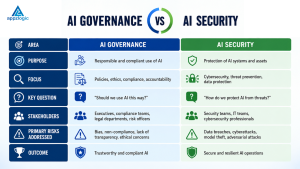
AI Governance and AI Security support each other, but each focuses on different things. Many companies bring in an AI cybersecurity consultant to help them see how governance and security impact compliance, operational risk, and system protection.
Why AI Governance and AI Security Must Work Together
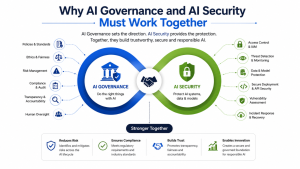
Many organizations mistakenly treat governance and security as separate tasks. In reality, they are closely linked, and both matter. AI Governance establishes the rules, policies, and oversight required for responsible AI adoption. AI Security protects the systems, data, and infrastructure that make AI possible.
For example:
- Governance may require customer data privacy.
- Security enforces that requirement through encryption and access controls.
- Governance may mandate fairness and transparency.
- Security ensures models are protected from tampering that could compromise fairness.
- Governance may define risk management policies.
- Security provides technical safeguards to reduce those risks.
When organizations combine governance and security, they create a stronger base for AI innovation and lower their legal, operational, and cybersecurity risks.
Challenges Organizations Face
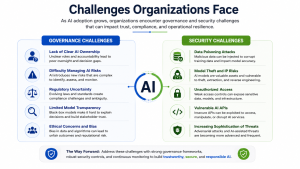
As more organizations adopt AI, they face various governance and security challenges that can affect trust, compliance, and operational effectiveness.
Governance Challenges
Organizations often struggle with unclear ownership and accountability for AI systems, making oversight and decision-making difficult. Managing AI risks is also tough because models and business needs change often. Unclear regulations make it harder to follow the rules, and limited transparency can reduce trust among stakeholders. Ethical issues such as bias, fairness, and responsible AI use are ongoing challenges that require regular attention and governance.
Security Challenges
AI systems are facing more cyberattacks. Data poisoning can degrade model accuracy by altering training data, and model theft can expose valuable intellectual property. If someone gains unauthorized access to AI systems, it can lead to data breaches and disrupt operations. Weak AI APIs can create security gaps, and as cyber threats grow more advanced, stronger protection is needed.
Moving Forward
To address these challenges, organizations need a balanced approach that integrates robust AI governance with advanced security controls. This helps keep AI systems compliant, transparent, secure, and trustworthy at every stage.
Building a Comprehensive AI Risk Management Strategy
Here are some best practices organizations should follow:
- Organizations should establish an AI governance framework, develop clear policies, define roles, set ethical guidelines, and plan compliance measures for AI projects.
- Put strong AI security controls in place, such as encryption, access controls, monitoring tools, and incident response plans, to keep AI environments safe.
- Conduct AI risk assessments and continuously monitor governance and security throughout the AI lifecycle.
- Monitor performance, fairness, changes, and security threats to ensure AI remains trustworthy and effective.
- Teams from governance, compliance, security, legal, and business should work together to effectively manage AI risks.
Conclusion
Organizations that invest in strong AI Governance, solid AI Security Controls, and proactive AI Risk Management are better able to build secure, compliant, and trustworthy AI systems. By combining responsible AI Governance with advanced AI Cybersecurity, businesses can reduce risks, keep pace with evolving regulations, and confidently scale their AI projects.
How Appzlogic Can Help
At Appzlogic, we help organizations improve AI Governance and AI Security with complete governance frameworks, AI risk management strategies, cybersecurity solutions, and compliance programs. Our experts support businesses in applying AI Governance Best Practices, enhancing Enterprise AI Security, and building AI ecosystems that are secure, scalable, and future-ready.
Frequently Asked Questions
AI Governance is a framework of policies, processes, and controls that ensures AI systems are developed and used responsibly, ethically, and in compliance with regulatory requirements. It helps organizations manage AI risks, maintain transparency, and ensure accountability.
AI Security focuses on protecting AI systems, models, data, and infrastructure from cyber threats, unauthorized access, data breaches, and malicious attacks. It ensures AI remains secure, reliable, and resilient.
AI Governance helps organizations ensure regulatory compliance, reduce bias, improve transparency, manage AI-related risks, and build trust among customers, employees, and stakeholders.
AI Security protects sensitive data, prevents unauthorized access, safeguards AI models from tampering, and helps organizations defend against emerging AI-specific cyber threats such as data poisoning and adversarial attacks.