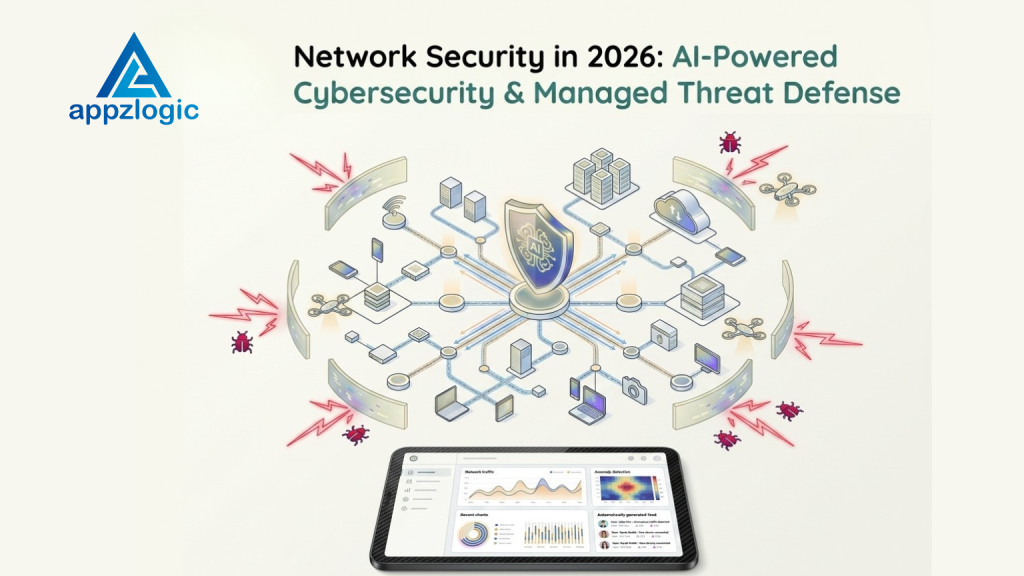
Network Security in 2026: AI-Powered Cybersecurity & Managed Threat Defense
By 2026, network security will depend on AI-powered systems that go above traditional firewalls and antivirus software. As cloud computing, IoT, remote work, and digital transformation grow, organizations face a much larger attack surface.
Today’s cybersecurity solutions need to be predictive, automated, and resilient. Companies should use AI, machine learning, and managed security services (MSS) to safeguard against advanced threats.
What is Network Security?
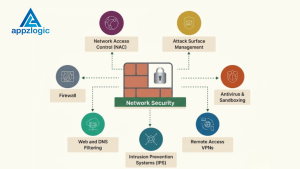
Network security brings together technologies, policies, and processes to protect networks, systems, and sensitive data from cyberattacks, unauthorized access, and data breaches.
Core Principles of Cybersecurity:
- Confidentiality- Secure access through encryption and identity management
- Integrity- Data protection against tampering and cyber threats
- Availability- Ensuring uptime and business continuity
By 2026, AI-powered network security will understand threats in real time, allowing instant detection and automated responses.
How Network Security Works
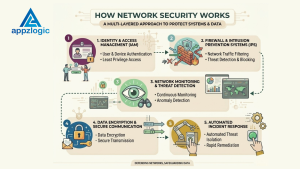
Modern network security uses a layered defense strategy, often called defense-in-depth:
- Identity & Access Management (IAM)—Multi-factor authentication (MFA) and AI-based risk assessment secure access.
- Network Monitoring & Threat Detection- AI-powered tools analyze traffic patterns for anomalies and cyber threats.
- Firewall & Intrusion Prevention Systems (IPS)- Block malicious traffic and unauthorized access attempts.
- Data Encryption & Secure Communication—Protects sensitive data across networks and cloud environments.
- Automated Incident Response- AI-driven systems detect and neutralize threats instantly.
This approach builds a proactive cybersecurity framework that moves away from older, reactive models.
Essential Components of Network Security
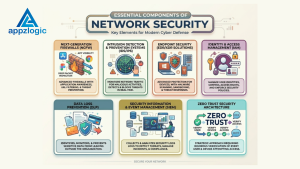
A solid network security strategy should include the following:
- Next-Generation Firewalls (NGFW)
- Intrusion Detection & Prevention Systems (IDS/IPS)
- Endpoint Security (EDR/XDR solutions)
- Identity & Access Management (IAM)
- Data Loss Prevention (DLP)
- Security Information & Event Management (SIEM)
- Zero Trust Security Architecture
AI and automation enhance these components, enabling faster, smarter threat detection.
Types of Network Security Solutions
Organizations use several cybersecurity solutions to protect their infrastructure:
- Cloud Security Solutions – Secure multi-cloud and hybrid environments
- Application Security – Protect web and mobile applications from vulnerabilities
- Endpoint Protection Platforms (EPP/EDR/XDR) – Secure devices and endpoints
- IoT Security – Protect connected devices and sensors
- Zero Trust Network Access (ZTNA) – Continuous identity verification
- AI-Powered Cybersecurity Platforms – Automated threat detection and response
Managed Security Services (MSS) for Threat Defense
By 2026, Managed Security Services (MSS) will be essential for organizations that need round-the-clock cybersecurity monitoring and threat defense but don’t want to build large in-house teams.
Key managed security services include the following:
- 24/7 Security Operations Center (SOC) monitoring
- Managed Detection and Response (MDR/XDR)
- Vulnerability Assessment & Penetration Testing (VAPT)
- Incident Response & Threat Mitigation
- Compliance & Risk Management
- Firewall and Network Management
AI in Managed Security Services:
- Real-time threat intelligence and anomaly detection
- Automated incident response and remediation
- Reduced false positives and alert fatigue
MSS offers scalable, cost-effective, AI-powered cybersecurity protection that modern businesses need.
Benefits of Network Security
Strong network security solutions offer the following:
- Protection against cyberattacks and ransomware. Network security shields organizations from threats like malware, ransomware, phishing, and unauthorized access. Ransomware can lock systems and demand payment to restore them. Without strong security, sensitive data could be stolen or destroyed.
- Data security and privacy compliance. Organizations handle a lot of sensitive data, like customer information and financial records. Good cybersecurity protects this data from breaches, helps meet regulations like GDPR and ISO, and avoids legal or financial trouble.
- Improved business continuity and uptime. Cyberattacks or system failures can cause downtime and hurt operations or revenue. Strong network security enables continuous monitoring, rapid recovery from backups, and early detection to prevent problems. reputation. Customers are increasingly concerned about data privacy and security. A single breach can damage a company’s reputation. Strong network security builds customer confidence, demonstrates commitment to data protection, and strengthens brand credibility.
- As organizations move to cloud computing, AI, IoT, and remote work, security is more important than ever. Network security helps companies safely use new technologies, migrate to the cloud, and protect digital assets on all platforms.
AI-powered security can cut response times from hours down to just seconds.
Challenges in Network Security
Organizations face multiple cybersecurity challenges:
- As technology advances, AI-powered cyber threats are on the rise. By 2026, attackers will use AI to launch complex cyberattacks, automate large-scale attacks, create personalized phishing emails, develop adaptive malware, and use deepfake technology for fraud and social engineering. Complex multi-cloud and hybrid IT environments create security gaps. Operating across multiple cloud platforms and on-premises systems offers flexibility but introduces challenges, including a lack of centralized visibility, misconfigurations, inconsistent security policies, and an increased attack surface.
- Shortage of skilled cybersecurity professionals. There aren’t enough cybersecurity experts worldwide, making it hard to build strong internal teams. Companies face limited talent, high hiring costs, constant training needs, and many security alerts to manage.
- High volume of security alerts and false positives. Modern systems can generate thousands of alerts every day, many of which are false alarms. This causes alert fatigue, makes it harder to spot real threats, slows responses, and increases the risk of missing real attacks. security with user experience. Strong security measures can sometimes impact user experience. Excessive alerts may cause fatigue, delay responses, and increase the risk of missing real threats.
- Managed security services, together with AI automation, are effective ways to tackle these challenges, especially in complex environments. Enterprise environments require advanced network security architecture: Multi-cloud security management requires unified visibility across all platforms. Micro-segmentation for breach of containment divides networks into smaller zones to contain breaches. Security Orchestration, Automation, and Response (SOAR) automate workflows across tools. Centralized security visibility comes from SIEM dashboards, where AI aggregates data from all systems into a single, unified view. This setup should be able to grow as the business expands. long-time correlation of threats across large networks.
Network Security Threats in 2026
Top cybersecurity threats include
- Ransomware-as-a-Service (RaaS) attackers sell ransomware kits, increasing attacks.
- AI-driven phishing and social engineering attacks, AI-generated emails, and deepfakes trick users.
- Distributed Denial-of-Service (DDoS) attacks Flood networks with traffic to cause downtime.
- Insider threats and data leaks: employees (intentionally or accidental) leak data.
- Zero-day vulnerabilities, attacks on unknown vulnerabilities.
- AI-generated malware, malware that adapts to evade detection.
- Supply chain cyberattacks compromise vendors’ access to larger systems.
AI Trends in Network Security (2026)
AI is reshaping cybersecurity and threat defense:
- Predictive threat intelligence prevents attacks before they occur.
- Autonomous security operations are self-operating security systems.
- Behavioral analytics detects insider threats.
- Self-healing networks’ automatic vulnerability fixes
- AI vs AI Cybersecurity fighting intelligent attacks
- Security Copilots AI assistants for security teams
Conclusion
By 2026, network security will be a must-have for every business. Companies need to use AI-powered cybersecurity, Zero Trust frameworks, managed security services (MSS), and automated threat detection and response.
Businesses that invest in advanced network security and AI-driven threat defense will be more resilient, earn long-term trust, and gain a competitive edge.
If you want to set up AI-powered network security solutions for your business, working with a trusted technology provider like Appzlogic can help.
Frequently Asked Questions
With the rise of AI, cloud computing, and IoT, cyber threats are more advanced. Strong network security helps prevent attacks, protect data, and ensure business continuity.
AI helps detect threats in real time, analyze behavior patterns, automate responses, and reduce human intervention in cybersecurity operations.
Common threats include ransomware, AI-driven phishing, DDoS attacks, insider threats, zero-day vulnerabilities, and supply chain attacks.
Businesses can adopt AI-powered tools, implement Zero Trust, use managed security services, and regularly conduct security assessments.