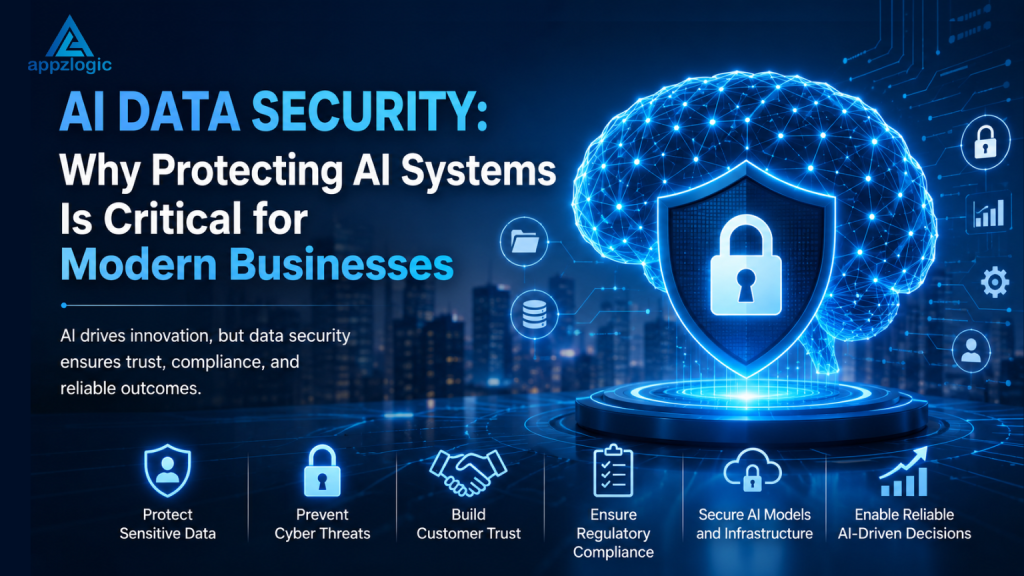
AI Data Security: Why Protecting AI Systems Is Critical for Modern Businesses
Artificial Intelligence (AI) is transforming business operations through automation, predictive analytics, virtual assistants, and autonomous systems. However, AI security relies on the quality and safety of its data. If this data is compromised or changed, organizations could face security breaches, inaccurate results, financial losses, and compliance problems. As AI adoption grows, it is important to implement robust data security measures to protect sensitive information, maintain AI system reliability, and build customer trust. This guide explains why AI data security is important, outlines common threats, shares best practices, and highlights new trends.
What Is AI Data Security?
AI data security involves using processes, technology, and policies to protect the data, models, and systems that power artificial intelligence throughout their life cycle. This includes securing training data, machine learning models, APIs, cloud environments, and AI outputs to ensure they remain private, accurate, available, and compliant. Unlike traditional cybersecurity, AI data protection also focuses on protecting the insights from AI models, enabling organizations to make reliable and secure decisions.
Why AI Data Security Matters
As organizations use AI in more areas, these systems handle more sensitive data than ever before. AI relies on large amounts of information, including customer details and business secrets, to deliver accurate insights and automate key tasks. Without strong security, organizations risk exposing valuable data and making their AI systems less reliable.
AI data security is essential because it helps organizations:
- Protect Customer Information: Safeguard personally identifiable information (PII) and sensitive customer data from unauthorized access and cyber threats.
- Secure Financial Records: Prevent theft or exposure of financial transactions, payment details, and confidential business data.
- Protect Healthcare Data: Ensure patient records and medical information remain secure and compliant with industry regulations.
- Safeguard Intellectual Property: Protect proprietary algorithms, AI models, source code, and business innovations from theft or misuse.
- Preserve Trade Secrets: Secure confidential business strategies, research, and competitive information.
- Protect Business Analytics: Prevent unauthorized access to AI-driven insights and business intelligence that support strategic decision-making.
- Secure Employee Information: Protect employee records, payroll details, and internal communications.
- Build Customer Trust: Demonstrate a strong commitment to data privacy and security to increase customer confidence.
- Prevent Data Breaches: Reduce the likelihood of cyberattacks, ransomware, and unauthorized data exposure.
- Protect AI Models from Manipulation: Defend against data poisoning, model theft, and adversarial attacks that can compromise AI performance.
- Maintain Regulatory Compliance: Meet the requirements of regulations such as GDPR, HIPAA, CCPA, and other data protection standards.
- Ensure Reliable AI Decisions: Maintain the accuracy, integrity, and trustworthiness of AI-generated insights and predictions.
- Reduce Operational Risk: Minimize financial losses, downtime, and business disruptions caused by security incidents.
- Safeguard Brand Reputation: Protect the organization’s reputation by preventing security breaches that can erode customer trust and market credibility.
Types of Data Used by AI Systems
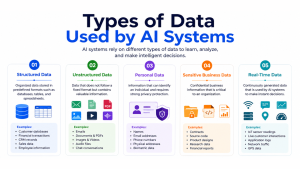
AI systems use various types of data to learn, analyze, and make decisions. Each type requires appropriate security measures to protect sensitive information.
-
Structured Data
Structured data is stored in well-defined formats, such as customer databases, financial transactions, CRM records, sales data, and employee information.
-
Unstructured Data
Unstructured data includes emails, documents, PDFs, images, videos, audio files, and chat conversations. AI analyzes this data to find useful insights.
-
Personal Data
Personal data is information that can identify a person, like names, email addresses, phone numbers, physical addresses, and biometric details. This data requires strong privacy protection.
-
Sensitive Business Data
Sensitive business data includes confidential information like contracts, source code, product designs, research data, intellectual property, and financial reports.
-
Real-Time Data
Real-time data is information that is generated continuously, such as IoT sensor readings, live customer interactions, application logs, network traffic, and GPS data. AI uses this data to make instant decisions.
Common AI Data Security Threats
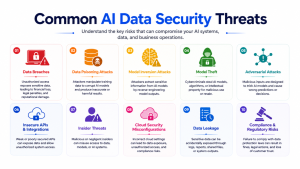
As organizations adopt AI, they face new security risks that can compromise sensitive data, AI models, and business operations. Below are some of the most common threats to AI data security.
-
Data Breaches
Unauthorized access to AI systems can expose sensitive customer and business data.
Consequences:
- Financial losses
- Legal penalties
- Brand reputation damage
- Loss of customer trust
-
Data Poisoning Attacks
Attackers inject malicious or inaccurate data into AI training datasets, causing models to make incorrect or biased decisions.
Impact:
- Inaccurate predictions
- Biased outputs
- Reduced model reliability
-
Model Theft
Cybercriminals may steal or copy trained AI models to exploit proprietary technology.
Risks:
- Model duplication
- Reverse engineering
- Intellectual property theft
-
Adversarial Attacks
Even small changes to AI inputs can change how a model behaves and lead to incorrect results.
Examples:
- Misclassifying images
- Bypassing AI detection systems
-
Insider Threats
Employees, contractors, or vendors who have authorized access might intentionally or accidentally expose sensitive AI data.
-
API Vulnerabilities
Poorly secured APIs can become entry points for cyberattacks.
Risks:
- Unauthorized access
- Data leaks
- Model abuse
- Credential theft
-
Prompt Injection Attacks
Malicious prompts can trick Large Language Models (LLMs) into bypassing safeguards or revealing sensitive information.
Risks:
- Information disclosure
- Security bypass
- Manipulated AI responses
Challenges in AI Data Security
Organizations face many challenges when trying to protect AI systems and the sensitive data they handle.
-
Massive Data Volumes
AI systems process large amounts of data across different environments, making it difficult to keep information secure and to monitor everything effectively.
-
Complex AI Pipelines
AI workflows involve steps like collecting and preparing data, training models, deploying them, and supporting ongoing learning. Each step comes with its own security risks.
-
Third-Party Dependencies
AI applications often depend on cloud providers, external APIs, pre-trained models, and open-source libraries. This reliance can increase supply chain security risks.
-
Privacy and Compliance
Organizations need to keep up with evolving data privacy regulations and ensure their AI systems remain secure and compliant.
-
Evolving Cyber Threats
Cybercriminals are using more AI-powered attacks, so organizations need to keep improving their AI security defenses.
Best Practices for AI Data Security
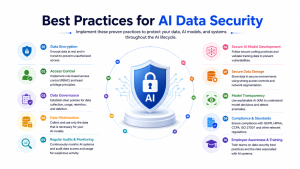
-
Encrypt Sensitive Data
Use strong encryption to protect data when it is stored, being sent, or backed up. This helps prevent unauthorized access.
-
Implement Role-Based Access Control (RBAC)
Grant access only to authorized users and always follow the principle of least privilege.
-
Enable Multi-Factor Authentication (MFA)
Require MFA for everyone who accesses AI systems to make accounts more secure.
-
Secure AI APIs
Protect APIs by using authentication, authorization, rate limiting, and ongoing monitoring.
-
Continuously Monitor AI Systems
Keep track of user activity, API requests, model behavior, and security events to spot threats early.
-
Validate Training Data
Verify data sources, remove duplicates, detect anomalies, and eliminate malicious data before model training.
-
Perform Regular Security Assessments
Conduct vulnerability assessments, penetration testing, AI risk assessments, and compliance audits regularly.
-
Protect AI Models
Secure AI models with access controls, encrypted storage, version management, and integrity checks.
-
Establish Strong Data Governance
Define clear policies for data quality, ownership, classification, retention, and regulatory compliance.
-
Train Employees on AI Security
Provide regular security awareness training to help employees identify phishing, social engineering, and AI-related threats.
AI Data Security and Compliance
Organizations using AI must comply with industry regulations, which vary by location and sector.
Common frameworks include:
- GDPR
- CCPA
- HIPAA
- SOC 2
- PCI DSS
- Emerging AI governance and AI-specific regulations
Compliance not only reduces legal risks but also builds customer trust.
AI Data Security Across Industries
- Healthcare: protect patient records, diagnostic systems, medical imaging, and clinical AI applications while ensuring regulatory compliance.
- Banking and Financial Services: secure fraud detection systems, customer financial information, digital payments, and AI-powered risk models.
- Retail and E-commerce: Protect customer purchase histories, payment information, recommendation engines, and personalization platforms.
- Manufacturing: Secure IoT devices, predictive maintenance systems, production analytics, and proprietary operational data.
- Government: Protect citizen information, national infrastructure, and AI-powered public services from cyber threats.
Emerging Trends in AI Data Security
AI data security is evolving rapidly as organizations adopt more advanced AI technologies, and cyber threats become increasingly sophisticated. Emerging trends such as AI-powered threat detection, Zero Trust security architectures, privacy-preserving machine learning, confidential computing, federated learning, synthetic data for AI training, automated compliance monitoring, AI governance platforms, explainable AI, and continuous AI risk assessment are helping organizations strengthen the security of their AI ecosystems. By investing in these innovations, businesses can better protect sensitive data, improve regulatory compliance, reduce security risks, and build more secure, trustworthy, and resilient AI systems.
Conclusion
Artificial Intelligence is transforming many industries, but its success depends on keeping its data secure. As organizations use AI more, they need to go beyond standard cybersecurity and adopt full AI data security strategies to protect data, models, APIs, and infrastructure. By using strong governance, secure development, ongoing monitoring, employee training, and following regulations, businesses can use AI with greater confidence and less risk. Enterprise AI data security solutions now will be better prepared to build trust, protect innovation, and grow in an increasingly AI-driven world.
At Appzlogic, we help organizations build AI solutions that are secure, scalable, and compliant. Our goal is to protect important data and support innovation with confidence.
Frequently Asked Questions
AI data security is the practice of protecting the data, models, APIs, and infrastructure used by AI systems from unauthorized access, manipulation, theft, and cyberattacks.
It protects sensitive information, ensures accurate AI outcomes, maintains regulatory compliance, and reduces the risk of data breaches and reputational damage.
Common threats include data breaches, data poisoning, model theft, adversarial attacks, prompt injection, insider threats, and insecure APIs.
Organizations can strengthen AI security by encrypting data, implementing access controls, securing APIs, validating training data, monitoring AI systems, conducting regular security assessments, and training employees.
Healthcare, banking, financial services, retail, manufacturing, government, and any organization handling sensitive or regulated data should prioritize AI data security.