Appzlogic Logo
Enhancing Aviation Maintenance and Safety by Automation

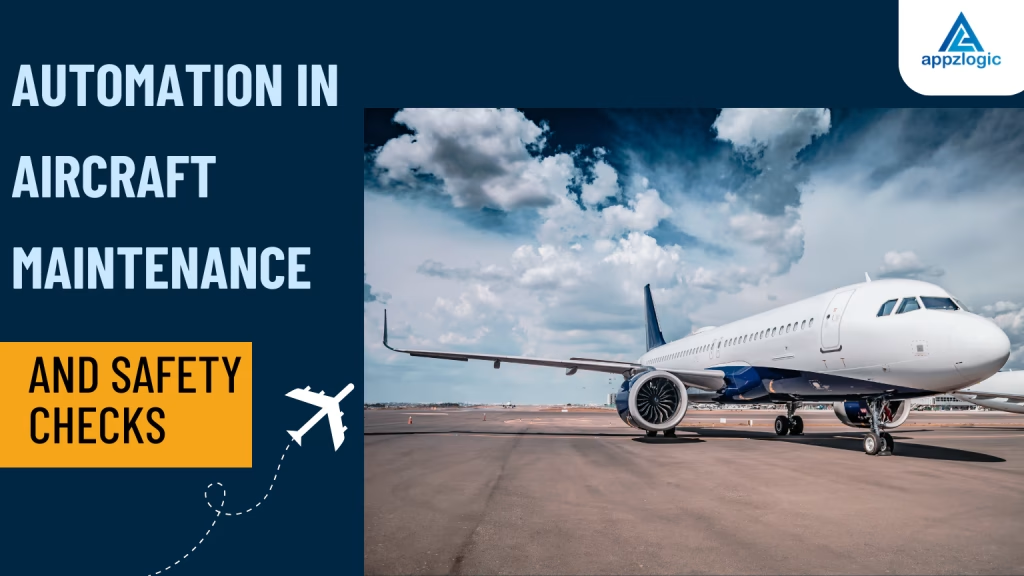
Automation in Aircraft Maintenance and Safety Checks

Airplane maintenance needs constant care to stay safe. Behind every flight is a long list of checks and fixes to make sure everything is working properly. In recent years, automation in aircraft maintenance and safety checks has become a key part of this process. It helps airlines carry out inspections, repairs, and safety steps more quickly and with better results. 

Maintenance checks are essential for keeping aircraft operational, but they often lead to flight delays and increased operating costs. To address this, aviation companies are turning to automated aircraft inspections to reduce downtime, optimize task planning, and improve parts management. 

Use of Automation in Aviation

How Automation is used in Aviation?

The use of automation in aviation has changed the way aircraft are maintained and monitored. Earlier, many tasks had to be done manually. Now, advanced systems help staff check engines, parts, and systems more easily.

Modern airplanes come with sensors that collect large amounts of data during every flight. These sensors monitor temperature, speed, vibration, and pressure in different parts of the plane. The collected data helps engineers find issues before they turn into serious problems.

Digital Tools for Smart Maintenance

One of the major improvements brought by automation is predictive maintenance. This means airlines no longer wait for parts to break. Instead, they fix or replace them before any damage occurs. Digital systems track the condition of parts in real-time. They analyze patterns and compare them with previous data to suggest when maintenance is needed. This way, airlines reduce costs and avoid delays. 

Automation in Aviation Industry

Across the aviation industry, automation is becoming part of daily operations. It is used not just in maintaining aircraft, but also in managing ground services, cargo handling, and even passenger check-ins. In aircraft servicing, robotic arms and automated scanners are used to inspect surfaces for cracks or dents. These machines do the job faster and more accurately than the human eye. 

Airports also benefit from automation. Ground control systems now use smart software to move planes safely between gates and runways. Luggage handling is more accurate, and fueling operations are monitored by automated tools that reduce risks. 

Robotic Inspections and Drones

Advantages of Robotic Security

Robots and drones are now part of regular inspection tasks. Drones fly around the aircraft, scanning areas that are difficult to reach. They take high-quality pictures and videos of the wings, engines, and tail. 

This helps identify even the smallest cracks, dents, or oil leaks. Unlike traditional methods that require scaffolding or ladders, drones save time and remove danger for workers. 

Robotic arms are used in engine repair shops. They perform cleaning, polishing, or even welding with great accuracy. These robots do repetitive tasks consistently, freeing up human workers for more complex tasks. 

Advantages of Automation in Aviation

The advantages of automation in aviation are easy to see. One of the most important is safety. Machines do not get tired or distracted. They follow the same process every time, which ensures that checks are done properly. 

Another benefit is time savings. Many tasks that used to take hours now take only minutes. As a result, planes spend less time on the ground and more time flying, which means more revenue for airlines and fewer delays for travelers. 

Automation also helps with cost control. By reducing surprise breakdowns, airlines avoid expensive emergency repairs. They also save money by using fuel more efficiently and managing spare parts better. 

Improved Accuracy and Less Human Error

Even the most experienced technician can make a mistake, especially during long shifts or in harsh weather. Automation reduces this risk by ensuring every check is done the same way every time. 

Digital systems do not miss out on the steps. They follow exact instructions and flag anything that looks unusual. This helps in catching issues early and avoiding problems later. 

Accuracy is also important when ordering replacement parts or recording maintenance history. Automated systems keep clear records that can be accessed anytime. 

Cybersecurity in Aviation

Integrating Security in Aviation Industry

It is critical to ensure the safety and reliability of modern aircraft systems and airport infrastructure. With increasing digitization, from flight control systems to passenger data management, the aviation industry faces growing threats from cyberattacks. Protecting communication networks, onboard software, and ground operations from breaches is essential to prevent disruptions, data theft, and potential safety risks. As a result, airlines and aviation authorities are investing heavily in advanced cybersecurity measures, real-time monitoring, and international cooperation to safeguard the skies. 

Airplane Automation

Airplane automation refers to the smart systems installed on modern planes. These systems help during takeoff, cruise, and landing. Most people know about autopilot, but now planes have far more advanced tools. 

Modern aircraft can manage speed, altitude, and direction with very little input from the pilot. They receive real-time updates from satellites and other aircraft. These updates help the plane adjust its route to avoid storms or busy airspace.

This kind of automation improves safety and saves fuel. It also reduces the workload on pilots, allowing them to focus on what really matters: communication, decision-making, and passenger comfort.

Read More about: How Airlines Use Data and AI to Prevent Aircraft Failures and Reduce Delays

Automated Ground Support Systems

Automation in Ground Operations

Airplane automation does not end when the plane lands. Once on the ground, it connects to smart systems at the airport. These systems guide the plane to its gate, manage refueling, and track passenger luggage. 

Smart fueling tools ensure that the right amount of fuel is loaded based on the flight distance and weather. This helps reduce waste and ensures the plane remains within the weight limits. 

Automated check-in systems also help passengers get on board faster. These tools reduce waiting times and improve the entire travel experience.

Future of Automation in Aviation

The future of automation in aviation looks bright. With every passing year, more tools and systems are introduced to make flying even safer and more efficient. 

New planes are being designed with built-in diagnostics. This means they can report problems while still in the air, allowing the ground team to prepare before the plane even lands. 

Artificial Intelligence (AI) will also play a larger role. It will help make smarter decisions about flight paths, fuel use, and repair plans. This will lead to even better safety records and smoother travel for everyone.

Conclusion

Automation in aircraft maintenance and safety checks has changed the way airlines operate. It brings speed, accuracy, and reliability to an industry where safety matters most. By using sensors, smart software, drones, and robots, airlines can now take care of their planes faster and with better results. Automation also supports pilots, improves airport operations, and creates a better travel experience for passengers.

Request a demo

Frequently Asked Questions

Automation helps detect problems early, schedule timely repairs, and perform checks with better accuracy. This keeps planes in top condition and reduces delays.

Yes, drones are safe and effective. They can access difficult spots without the need for ladders or lifts, making inspections quicker and safer.

Yes. Pilots remain in full control. Automation helps by managing routine tasks, so pilots can focus on important decisions.

Absolutely. By avoiding breakdowns, improving fuel use, and speeding up processes, automation helps airlines save money over time.

No. Many smaller airlines and regional airports are also adopting automated tools to improve safety and service.
What Is a Global Capability Center (GCC)?

A Global Capability Center (GCC) is a unit an organization sets up to support its global operations through technology, skilled talent, innovation, and business know-how. In the past, these centers were mainly called captive centers or offshore development centers and focused on saving costs. Today, modern Global Capability Centers act as innovation hubs, helping organizations […]

How AI is Revolutionizing the Virtual Assistant

How AI Is Helping The Virtual Assistant World?

AI-powered virtual assistants help individuals and businesses manage tasks efficiently. They significantly enhance efficiency by automating routine activities such as organizing schedules, handling emails, and processing requests.   With AI, people can focus on important tasks while the assistant takes care of repetitive and time-consuming work also AI is transforming industries by automating processes and […]

From Prototype to Production: How to Build a Secure Enterprise Generative AI Application That Businesses Can Trust

Generative AI has quickly shifted from an experiment to an essential business tool. Companies in fields like healthcare, banking, retail, manufacturing, legal, and customer service now use AI assistants, smart search, coding tools, document automation, and AI agents to work more efficiently and serve customers better. However, building an enterprise Generative AI app is more complex than just […]

Finance processes involve numerous tasks, multiple approvals, and strict compliance requirements, making them inherently complex and time-consuming. Organizations need a way to ensure that workflows are consistent, efficient, and transparent across departments while reducing errors and delays. Camunda BPM offers a powerful solution by enabling businesses to design, automate, and manage workflows using BPMN business process model and notation. With Camunda, finance teams can visualize processes clearly, implement automated tasks, and integrate workflows seamlessly with existing systems, improving overall efficiency and accuracy. By providing a structured framework for managing transactions, compliance checks, customer interactions, and reporting, Camunda simplifies the execution of finance processes, ensuring operations remain reliable, accountable, and easy to monitor. What is Camunda BPM? Camunda BPM is an open-source BPM platform built to execute and automate workflows created with BPMN. It enables organizations to design processes clearly, automate repetitive tasks, and manage complex workflows efficiently. Unlike traditional systems, Camunda offers flexibility, allowing businesses to adapt processes as their needs evolve without being tied to proprietary solutions. The platform is especially valuable for financial institutions because it supports critical operations such as compliance workflows, transaction monitoring, customer support processes, and regulatory reporting. Its seamless integration with existing systems through the Camunda API ensures that workflows operate smoothly across different departments and applications. By using Camunda BPM, organizations gain better control, transparency, and efficiency in their business processes, while also reducing risks and ensuring consistent performance across all operations. What is a BPMN Diagram? A BPMN diagram is the visual output of business process modeling. It shows tasks, events, and BPMN gateways that represent decision points in a process. For finance processes, these diagrams can illustrate how a loan request moves from submission to approval or rejection. Using a BPM platform like Camunda, financial organizations can move from static diagrams to executable workflows that directly integrate with systems and applications. What is BPMN in Business Analysis? Business analysts use BPMN because it provides a shared language for finance teams and IT departments, reducing miscommunication and ensuring everyone understands the same workflow. BPMN diagrams visually represent processes in a structured way, showing tasks, events, and decision points clearly. This makes it easier to identify inefficiencies, enforce compliance requirements, and uncover opportunities for automation using BPM automation tools. Beyond mapping processes, BPMN helps finance teams document workflows for audits, training, and continuous improvement. Analysts can track how tasks are performed, highlight repetitive steps that could be automated, and ensure that critical controls are in place. By using BPMN, organizations can align operational execution with strategic goals, monitor performance, and quickly adapt workflows as regulations or business priorities change. This approach supports transparency, accountability, and efficiency across all finance processes, helping teams deliver consistent results. Camunda Modeler The Camunda Modeler is a desktop application that allows users to design workflows using BPMN 2.0. When finance teams ask how to use Camunda Modeler, the answer is simple: it offers a drag-and-drop interface where you can design processes with tasks, events, and gateways.For instance, a financial compliance officer can use Camunda Modeler to build a process diagram for anti-money laundering checks. Once designed, the workflow can be deployed into the Camunda BPM engine, ensuring the process runs automatically. BPM Automation Tools in Finance Financial services require reliable BPM automation tools to handle high volumes of repetitive tasks. Camunda’s workflow automation ensures processes like payment reconciliation or fraud detection run consistently and accurately. Unlike traditional tools, Camunda does not act as a black box. Teams can monitor workflows in real time, adjust business rules, and continuously improve their models. This transparency is especially valuable in regulated industries where auditability is crucial. Camunda Workflow for Finance The Camunda workflow engine is the heart of execution. Once a business process model is created in the Modeler, the workflow engine ensures tasks are executed in order, data is routed correctly, and escalations happen on time. Camunda workflow is widely applied in loan application approvals, fraud detection checks, regulatory compliance reporting, and customer onboarding verification. With BPMN gateways, workflows can branch into different paths based on conditions, such as risk level or credit score. Camunda API for Integration One of the most powerful aspects of Camunda is its API design, which ensures that organizations can seamlessly connect their workflows with existing systems and applications. The Camunda API makes it possible for financial institutions to bring together multiple platforms, ranging from customer management systems and payment gateways to compliance and reporting solutions, into a single, unified process. This level of connectivity ensures that data moves smoothly across different departments, reducing silos and enhancing collaboration. We also use the Camunda API to help financial organizations to build integrated environments where workflows are not limited to a single tool but interact effortlessly with core banking platforms, regulatory systems, and enterprise applications. This approach provides finance teams with greater flexibility, visibility, and control, ensuring that their operations remain accurate. Business Process Modeling and Compliance Financial institutions operate under strict regulations, and ensuring compliance is a critical part of every workflow. Through business process modeling, organizations can embed compliance checks directly into their processes, making them an integral part of day-to-day operations rather than separate tasks. Using BPMN 2.0, rules and regulations are represented clearly and become part of the executable workflow, which ensures that every step follows established guidelines. This approach not only helps teams maintain accuracy and consistency but also provides transparency, making it easier to track processes and demonstrate compliance during audits. By integrating compliance into the workflow itself, financial organizations reduce the risk of errors or oversights, improve accountability, and create a system where regulatory requirements are consistently met across all operations. Camunda Enterprise Pricing When organizations consider adopting Camunda at an enterprise level, understanding Camunda enterprise pricing becomes important. While the open-source version provides robust workflow automation, the enterprise edition adds advanced capabilities such as dedicated support, enhanced monitoring tools, and greater scalability for large-scale operations. For financial institutions with high transaction volumes, complex compliance requirements, and critical regulatory obligations, the enterprise edition ensures that workflows remain reliable, secure, and efficient. By choosing enterprise features, organizations can manage processes confidently and maintain stability across all finance operations. Advantages of Camunda BPM Platform in Finance The BPM platform provided by Camunda offers multiple advantages for finance. Using business process model and notation, workflows become standardized across teams, ensuring clarity and consistency. The platform also provides transparency because workflows can be monitored in real time. Its flexibility is a major benefit as well, since through the Camunda API it integrates smoothly with core banking and compliance systems. Efficiency is improved as automated workflows reduce manual errors and delays, and scalability ensures that Camunda can serve both small financial teams and global banking organizations. How Finance Teams Use Camunda? Finance teams apply Camunda in multiple ways. Transaction approvals are automated with BPMN gateways, customer onboarding processes are enhanced through automated KYC checks, and compliance monitoring is handled by rule-based workflows.By combining business process modeling with automation, Camunda helps finance teams reduce costs while improving customer experiences. Conclusion Camunda BPM offers financial institutions a practical and efficient way to manage complex workflows, enforce compliance, and automate critical tasks. By using BPMN 2.0, organizations can clearly visualize processes, integrate systems through the Camunda API, and ensure that operations run smoothly and reliably. With tools like Camunda Modeler and BPM automation tools, finance teams gain transparency, control, and the ability to continuously improve workflows. At Appzlogic, we support organizations in including these capabilities and helping teams to implement Camunda effectively and ensuring that finance processes are not only automated but also aligned with operational and compliance requirements.

How Does Camunda Make BPMN Easier for Finance Processes?

Finance processes involve numerous tasks, multiple approvals, and strict compliance requirements, making them inherently complex and time-consuming. Organizations need a way to ensure that workflows are consistent, efficient, and transparent across departments while reducing errors and delays. Camunda BPM offers a powerful solution by enabling businesses to design, automate, and manage workflows using BPMN business […]