Appzlogic Logo

What is GRC (Governance, Risk, and Compliance)? A Complete Guide for Modern Businesses

What is GRC? 

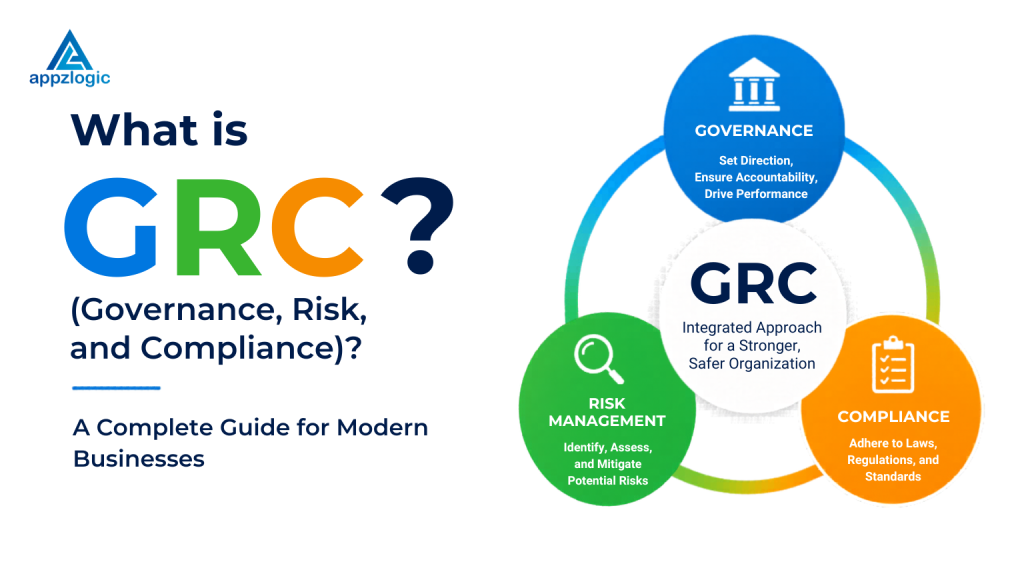
Governance, Risk, and Compliance (GRC) is a framework that helps organizations manage these three areas together in a coordinated way. 

The pillars of the GRC framework combine: 

  1. Governance

Governance means having the right policies, processes, and decision-making structures in place to help an organization reach its goals. 

Key governance activities include establishing corporate policies and procedures, defining roles and responsibilities, ensuring accountability and transparency, aligning IT and business strategies, and monitoring organizational performance. 

  1. Risk Management

Risk management involves identifying, assessing, reducing, and monitoring risks that could impact business operations. 

Common risk categories include cybersecurity risks, operational risks, financial risks, third-party risks, legal and regulatory risks, and reputational risks. 

  1. Compliance

Compliance is about ensuring organizations follow laws, regulations, industry standards, and their own policies. 

Examples include GDPR, ISO 27001, HIPAA, PCI DSS, SOC 2, NIST Framework, and industry-specific regulations. 

Why is GRC Important? 

Organizations now operate in a world full of rules and risks. Without a clear GRC strategy, they may run into compliance issues, security challenges, inefficiencies, and even financial penalties. 

Benefits of GRC 

  • Better Risk Visibility: GRC helps organizations identify and assess risk management and compliance across every department, providing a comprehensive view of potential threats. 
  • Improved Regulatory Compliance: A robust GRC framework helps organizations stay compliant with evolving regulations and reduces the risk of fines or legal issues. 
  • Better Decision-Making: Leaders receive up-to-date information on risks and compliance, enabling them to make smarter decisions. 
  • Operational Efficiency: By bringing governance, risk, and compliance activities together, organizations can cut out duplicate work and reduce administrative tasks. 
  • Stronger Cybersecurity: Cybersecurity GRC frameworks help organizations proactively manage security by identifying weaknesses and implementing the right controls. 
  • Greater Stakeholder Confidence: Good governance and compliance build trust with customers, partners, investors, and regulators. 

How Does GRC Work? 
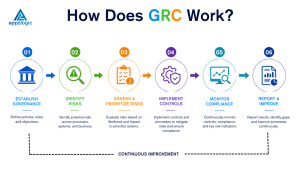
GRC is a system that integrates governance policies, risk management, and compliance into a single, central framework. 

Step 1: Establish Governance Policies 

Organizations define their business goals, set policies and standards, and assign responsibilities to align IT governance with business objectives. 

Step 2: Identify Risks 

Organizations identify potential enterprise risk assessments across their business processes, IT systems, vendors, and operations. 

Step 3: Assess and Prioritize Risks 

They evaluate how likely and serious each risk is, so they can focus on the most important ones. 

Step 4: Implement Controls 

Organizations put security controls, safeguards, and compliance measures in place to reduce their risks. 

Step 5: Monitor Compliance 

Ongoing monitoring helps organizations stay compliant with regulations, standards, and their own policies. 

Step 6: Reporting and Improvement 

Regular reports show how well organizations manage risks and compliance, helping them continue to improve. 

Key Components of an Effective GRC Framework 

A strong GRC program typically includes: 

Policy Management 

  • Policy creation and maintenance 
  • Policy distribution and acknowledgment 
  • Policy review and updates 

Risk Assessment 

  • Risk identification 
  • Risk scoring and prioritization 
  • Risk treatment planning 

Compliance Management 

  • Regulatory tracking 
  • Compliance audits 
  • Gap assessments 

Internal Controls 

  • Access controls 
  • Security controls 
  • Process controls 

Audit Management 

  • Internal audits 
  • External audit preparation 
  • Audit documentation 

Continuous Monitoring 

  • Real-time risk monitoring 
  • Compliance dashboards 
  • Automated alerts and reporting 

How Do Organizations Implement an Effective GRC Strategy? 
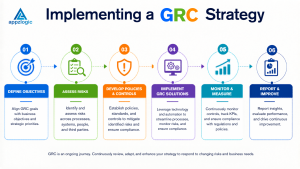
GRC implementation requires organizations to have a clear, company-wide plan. 

  1. Define Business Objectives

Start by ensuring GRC efforts align with the organization’s goals and top priorities. 

Questions to consider: 

  • What risks could impact business growth? 
  • Which regulations apply to the organization? 
  • What governance structures are needed? 
  1. Conduct a Risk Assessment

Identify existing and emerging risks across: 

  • Technology 
  • Operations 
  • Finance 
  • Vendors 
  • Compliance 

A thorough risk assessment forms the foundation of a strong GRC program. 

  1. Develop Policies and Controls

Create clear policies and implement controls to address the risks and rules you have identified. 

Examples include: 

  • Access management policies 
  • Data protection policies 
  • Incident response procedures 
  • Vendor risk management policies 
  1. Implement GRC Technology

Modern GRC platforms help organizations: 

  • Automate compliance processes 
  • Track risks 
  • Generate reports 
  • Monitor controls 
  • Manage audits 

Automation makes these processes more efficient and easier to track. 

  1. Promote a Risk-Aware Culture

GRC isn’t just for IT. Everyone in the organization should understand their role in managing risks and staying compliant. 

Organizations should: 

  • Conduct regular training 
  • Promote security awareness 
  • Encourage accountability 
  1. Continuously Monitor and Improve

GRC is an ongoing process. Organizations need to continually evaluate risks, monitor compliance, and update controls as the business and regulatory environments change. 

Common Challenges in GRC Implementation 
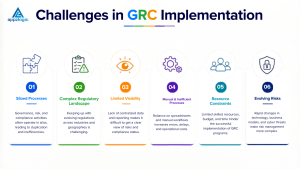
Despite its benefits, organizations often encounter challenges such as: 

  • Siloed Processes—Independent management of governance, risk, and compliance across departments can lead to inefficiencies. 
  • Regulatory Complexity: It can be difficult to keep up with changing regulations in different regions. 
  • Limited Visibility: Without central reporting, organizations struggle to see all their risks and understand their compliance status. 
  • Manual Processes: Tracking risks and compliance in spreadsheets often leads to errors and wasted time. 
  • Resource Constraints: Many organizations lack sufficient staff or expertise to manage GRC programs effectively. 

Best Practices for Successful GRC Implementation 

To make the most of GRC, organizations should: 

  • Align GRC initiatives with business goals. 
  • Establish executive sponsorship 
  • Automate risk and compliance processes 
  • Implement continuous monitoring 
  • Conduct regular audits and assessments. 
  • Maintain updated policies and procedures. 
  • Foster cross-functional collaboration 
  • Leverage data-driven decision-making 

How Can Appzlogic Help with GRC? 

As cybersecurity threats and regulatory demands grow, having the right technology partner is essential for building a strong GRC framework. 

Appzlogic supports organizations in improving their Governance, Risk, and Compliance efforts by offering cybersecurity expertise, technology guidance, and enterprise solutions. 

Governance Support 

  • Development of governance frameworks 
  • Policy and process standardization 
  • IT governance implementation 
  • Security governance advisory 

Risk Management Services 

  • Enterprise risk assessments 
  • Cybersecurity risk analysis 
  • Vulnerability assessments 
  • Third-party risk evaluations 
  • Business continuity planning 

Compliance Enablement 

  • Compliance readiness assessments 
  • Gap analysis and remediation planning 
  • Support for ISO 27001, SOC 2, GDPR, HIPAA, and other frameworks 
  • Audit preparation and documentation assistance 

Security and Monitoring 

  • Continuous security monitoring 
  • Threat detection and response 
  • Identity and access management 
  • Security operations support 

Automation and Digital Transformation 

  • GRC process automation 
  • Workflow optimization 
  • Data-driven compliance reporting 
  • Integration with enterprise platforms 

By bringing together industry expertise, cybersecurity skills, and enterprise technology solutions, Appzlogic helps organizations build a proactive and scalable GRC strategy that supports business growth and reduces risk. 

Governance, Risk, and Compliance has become a key business function, not just a regulatory requirement. It helps organizations manage complex risks, remain compliant, and achieve their goals. A strong GRC framework makes operations more efficient, strengthens cybersecurity, improves decision-making, and builds trust. 

As businesses become more digital, investing in a strong GRC strategy can give them a real advantage. With the right approach and GRC consulting services partner, organizations can turn GRC from a requirement into a tool for resilience and growth. 

Request a demo

Frequently Asked Questions

Governance, Risk, and Compliance (GRC) is a framework that helps organizations align business objectives with risk management and regulatory compliance. It integrates governance practices, risk assessment, and compliance requirements into a unified approach.

GRC helps organizations improve decision-making, manage risks effectively, meet regulatory requirements, enhance cybersecurity, and build trust with stakeholders while reducing operational and compliance-related risks.

The future of GRC includes increased automation, AI-driven risk analysis, continuous compliance monitoring, integrated cybersecurity management, and real-time reporting to support proactive decision-making.

Organizations should review their GRC framework regularly, typically annually or whenever significant business, regulatory, or cybersecurity changes occur.

GRC helps organizations identify security risks, implement controls, monitor vulnerabilities, comply with security regulations, and strengthen their overall cybersecurity strategy.
Trends to monitor in cybersecurity

Cybersecurity Trends to Monitor in 2025

With evolving technology, cybersecurity presents both new challenges and opportunities for businesses worldwide. The increasing sophistication of cyber threats demands strong security measures and a proactive approach to protecting digital assets. Importance of Cybersecurity Cybersecurity is essential to protect sensitive data, systems, and networks from cyber threats such as hacking, malware, and data breaches. With […]

Enhancing Aviation Maintenance and Safety by Automation

Automation in Aircraft Maintenance and Safety Checks

Airplane maintenance needs constant care to stay safe. Behind every flight is a long list of checks and fixes to make sure everything is working properly. In recent years, automation in aircraft maintenance and safety checks has become a key part of this process. It helps airlines carry out inspections, repairs, and safety steps more […]

Finance processes involve numerous tasks, multiple approvals, and strict compliance requirements, making them inherently complex and time-consuming. Organizations need a way to ensure that workflows are consistent, efficient, and transparent across departments while reducing errors and delays. Camunda BPM offers a powerful solution by enabling businesses to design, automate, and manage workflows using BPMN business process model and notation. With Camunda, finance teams can visualize processes clearly, implement automated tasks, and integrate workflows seamlessly with existing systems, improving overall efficiency and accuracy. By providing a structured framework for managing transactions, compliance checks, customer interactions, and reporting, Camunda simplifies the execution of finance processes, ensuring operations remain reliable, accountable, and easy to monitor. What is Camunda BPM? Camunda BPM is an open-source BPM platform built to execute and automate workflows created with BPMN. It enables organizations to design processes clearly, automate repetitive tasks, and manage complex workflows efficiently. Unlike traditional systems, Camunda offers flexibility, allowing businesses to adapt processes as their needs evolve without being tied to proprietary solutions. The platform is especially valuable for financial institutions because it supports critical operations such as compliance workflows, transaction monitoring, customer support processes, and regulatory reporting. Its seamless integration with existing systems through the Camunda API ensures that workflows operate smoothly across different departments and applications. By using Camunda BPM, organizations gain better control, transparency, and efficiency in their business processes, while also reducing risks and ensuring consistent performance across all operations. What is a BPMN Diagram? A BPMN diagram is the visual output of business process modeling. It shows tasks, events, and BPMN gateways that represent decision points in a process. For finance processes, these diagrams can illustrate how a loan request moves from submission to approval or rejection. Using a BPM platform like Camunda, financial organizations can move from static diagrams to executable workflows that directly integrate with systems and applications. What is BPMN in Business Analysis? Business analysts use BPMN because it provides a shared language for finance teams and IT departments, reducing miscommunication and ensuring everyone understands the same workflow. BPMN diagrams visually represent processes in a structured way, showing tasks, events, and decision points clearly. This makes it easier to identify inefficiencies, enforce compliance requirements, and uncover opportunities for automation using BPM automation tools. Beyond mapping processes, BPMN helps finance teams document workflows for audits, training, and continuous improvement. Analysts can track how tasks are performed, highlight repetitive steps that could be automated, and ensure that critical controls are in place. By using BPMN, organizations can align operational execution with strategic goals, monitor performance, and quickly adapt workflows as regulations or business priorities change. This approach supports transparency, accountability, and efficiency across all finance processes, helping teams deliver consistent results. Camunda Modeler The Camunda Modeler is a desktop application that allows users to design workflows using BPMN 2.0. When finance teams ask how to use Camunda Modeler, the answer is simple: it offers a drag-and-drop interface where you can design processes with tasks, events, and gateways.For instance, a financial compliance officer can use Camunda Modeler to build a process diagram for anti-money laundering checks. Once designed, the workflow can be deployed into the Camunda BPM engine, ensuring the process runs automatically. BPM Automation Tools in Finance Financial services require reliable BPM automation tools to handle high volumes of repetitive tasks. Camunda’s workflow automation ensures processes like payment reconciliation or fraud detection run consistently and accurately. Unlike traditional tools, Camunda does not act as a black box. Teams can monitor workflows in real time, adjust business rules, and continuously improve their models. This transparency is especially valuable in regulated industries where auditability is crucial. Camunda Workflow for Finance The Camunda workflow engine is the heart of execution. Once a business process model is created in the Modeler, the workflow engine ensures tasks are executed in order, data is routed correctly, and escalations happen on time. Camunda workflow is widely applied in loan application approvals, fraud detection checks, regulatory compliance reporting, and customer onboarding verification. With BPMN gateways, workflows can branch into different paths based on conditions, such as risk level or credit score. Camunda API for Integration One of the most powerful aspects of Camunda is its API design, which ensures that organizations can seamlessly connect their workflows with existing systems and applications. The Camunda API makes it possible for financial institutions to bring together multiple platforms, ranging from customer management systems and payment gateways to compliance and reporting solutions, into a single, unified process. This level of connectivity ensures that data moves smoothly across different departments, reducing silos and enhancing collaboration. We also use the Camunda API to help financial organizations to build integrated environments where workflows are not limited to a single tool but interact effortlessly with core banking platforms, regulatory systems, and enterprise applications. This approach provides finance teams with greater flexibility, visibility, and control, ensuring that their operations remain accurate. Business Process Modeling and Compliance Financial institutions operate under strict regulations, and ensuring compliance is a critical part of every workflow. Through business process modeling, organizations can embed compliance checks directly into their processes, making them an integral part of day-to-day operations rather than separate tasks. Using BPMN 2.0, rules and regulations are represented clearly and become part of the executable workflow, which ensures that every step follows established guidelines. This approach not only helps teams maintain accuracy and consistency but also provides transparency, making it easier to track processes and demonstrate compliance during audits. By integrating compliance into the workflow itself, financial organizations reduce the risk of errors or oversights, improve accountability, and create a system where regulatory requirements are consistently met across all operations. Camunda Enterprise Pricing When organizations consider adopting Camunda at an enterprise level, understanding Camunda enterprise pricing becomes important. While the open-source version provides robust workflow automation, the enterprise edition adds advanced capabilities such as dedicated support, enhanced monitoring tools, and greater scalability for large-scale operations. For financial institutions with high transaction volumes, complex compliance requirements, and critical regulatory obligations, the enterprise edition ensures that workflows remain reliable, secure, and efficient. By choosing enterprise features, organizations can manage processes confidently and maintain stability across all finance operations. Advantages of Camunda BPM Platform in Finance The BPM platform provided by Camunda offers multiple advantages for finance. Using business process model and notation, workflows become standardized across teams, ensuring clarity and consistency. The platform also provides transparency because workflows can be monitored in real time. Its flexibility is a major benefit as well, since through the Camunda API it integrates smoothly with core banking and compliance systems. Efficiency is improved as automated workflows reduce manual errors and delays, and scalability ensures that Camunda can serve both small financial teams and global banking organizations. How Finance Teams Use Camunda? Finance teams apply Camunda in multiple ways. Transaction approvals are automated with BPMN gateways, customer onboarding processes are enhanced through automated KYC checks, and compliance monitoring is handled by rule-based workflows.By combining business process modeling with automation, Camunda helps finance teams reduce costs while improving customer experiences. Conclusion Camunda BPM offers financial institutions a practical and efficient way to manage complex workflows, enforce compliance, and automate critical tasks. By using BPMN 2.0, organizations can clearly visualize processes, integrate systems through the Camunda API, and ensure that operations run smoothly and reliably. With tools like Camunda Modeler and BPM automation tools, finance teams gain transparency, control, and the ability to continuously improve workflows. At Appzlogic, we support organizations in including these capabilities and helping teams to implement Camunda effectively and ensuring that finance processes are not only automated but also aligned with operational and compliance requirements.

How Does Camunda Make BPMN Easier for Finance Processes?

Finance processes involve numerous tasks, multiple approvals, and strict compliance requirements, making them inherently complex and time-consuming. Organizations need a way to ensure that workflows are consistent, efficient, and transparent across departments while reducing errors and delays. Camunda BPM offers a powerful solution by enabling businesses to design, automate, and manage workflows using BPMN business […]