
Appzlogic Logo

Top Cybersecurity Challenges in Banking and How to Overcome Them

Growing Cyber Threat Landscape in Banking

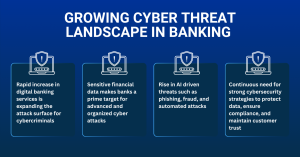
The banking and financial services sector continues to face constant pressure from cyber threats as more services move online. Customers rely on mobile apps, internet banking, and digital payment systems for daily transactions, which increases both convenience and risk. Cybercriminals target banks because of the sensitive financial data they manage. Institutions must continuously improve their cybersecurity strategies to protect data, maintain trust, and meet regulatory expectations. Strong and consistent security practices are necessary for long term growth and stability.
Increasing Phishing and Social Engineering Attacks

One of the most common and dangerous threats in banking is phishing. Attackers use fake emails, messages, or websites to trick users into sharing confidential details such as passwords, card numbers, or one time passwords. These attacks are becoming more advanced with artificial intelligence, making them look more realistic and harder to detect. Customers often struggle to identify fake communication, which increases the chances of fraud. Banks need to focus on awareness programs and advanced filtering systems to reduce such risks.

Rise of Ransomware Attacks

Ransomware attacks are rising in the financial sector and causing serious disruptions. Hackers lock access to important systems or data and demand payment to restore it. This creates operational challenges because banks depend on constant system availability. Even a short interruption can affect thousands of users and lead to financial losses. To manage this risk, banks should invest in data backup systems, network monitoring, and strong endpoint protection. Quick response strategies can help limit the impact of such attacks.

Insider Threats and Employee Risks

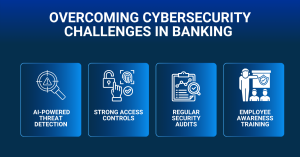
Insider threats are another major concern in banking security. These threats can come from employees who misuse access or make unintentional mistakes. Weak passwords, sharing login details, or clicking unsafe links can create serious vulnerabilities. In some cases, employees may misuse data for personal reasons. Banks must implement strict access control systems where employees only access necessary information. Regular training and monitoring help reduce human errors and improve security awareness.

Security Challenges in Digital Banking Platforms

The rapid growth of digital banking platforms has increased security concerns. Mobile applications, online systems, and payment gateways are now essential for customer interaction. If these systems have vulnerabilities, attackers can exploit them to gain unauthorized access. Weak application security or poorly managed APIs can become entry points for attacks. Banks must perform regular testing, code reviews, and vulnerability checks to keep platforms secure. Continuous updates also play an important role in maintaining safety.

Third Party and Supply Chain Risks

Banks often work with external vendors and service providers to deliver services. These partnerships can introduce security risks if third party systems are not properly protected. A compromised vendor system can create a pathway for attackers to access banking networks. Managing these risks requires careful vendor selection, regular audits, and clear security policies. A zero trust approach where every access request is verified can further strengthen protection across systems.

Regulatory Compliance and Data Protection

Regulatory compliance is a critical part of banking cybersecurity. Financial institutions must follow strict data protection laws and security regulations. Failure to comply can result in penalties and damage to reputation. Compliance also helps in maintaining strong security practices such as data encryption, identity management, and system monitoring. Banks need to stay updated with changing regulations and ensure that their systems meet industry standards.

Cloud Security Challenges in Banking

The use of cloud technology in banking has introduced new security concerns. While cloud platforms offer flexibility and cost benefits, they require proper configuration and monitoring. Incorrect settings can expose sensitive data to unauthorized users. Banks must work closely with cloud providers to ensure secure deployment. Strong authentication and access control measures are essential to protect data stored in cloud environments.

Role of Artificial Intelligence in Cybersecurity

Artificial intelligence is playing an important role in both cyber attacks and defense strategies. Attackers use AI to automate phishing campaigns and identify weaknesses faster. At the same time, banks use AI tools to detect unusual activities and prevent fraud in real time. This creates a continuous cycle where both sides improve their capabilities. Investing in AI based security solutions helps banks respond to threats quickly and effectively.
Importance of Customer Awareness

Customer behavior plays a key role in banking security. Many users are not fully aware of cybersecurity risks and may unknowingly expose their information. Using public networks or ignoring security warnings can increase the chances of fraud. Banks must educate customers about safe practices and encourage them to use security features such as two factor authentication. Awareness can significantly reduce risks and improve overall security.

Conclusion

Cybersecurity challenges in banking continue to grow with the expansion of technology. From phishing and ransomware to insider threats and supply chain risks, financial institutions face multiple security concerns. Addressing these issues requires advanced tools, strong policies, and continuous awareness. Banks must take a proactive approach by investing in modern security solutions and updating their systems regularly. Protecting customer data and maintaining trust should always remain the top priority.

Request a demo

Frequently Asked Questions

The biggest challenges include phishing attacks, ransomware, insider threats, third-party risks, cloud security issues, and vulnerabilities in digital banking platforms.

Banks are prime targets because they handle sensitive financial data and large volumes of transactions, making them highly valuable for cybercriminals.

AI helps detect unusual activities, prevent fraud in real time, and strengthen overall threat detection and response capabilities.

Banks can improve cybersecurity by adopting advanced security tools, regular system updates, employee training, and strong compliance practices.

Finance processes involve numerous tasks, multiple approvals, and strict compliance requirements, making them inherently complex and time-consuming. Organizations need a way to ensure that workflows are consistent, efficient, and transparent across departments while reducing errors and delays. Camunda BPM offers a powerful solution by enabling businesses to design, automate, and manage workflows using BPMN business process model and notation. With Camunda, finance teams can visualize processes clearly, implement automated tasks, and integrate workflows seamlessly with existing systems, improving overall efficiency and accuracy. By providing a structured framework for managing transactions, compliance checks, customer interactions, and reporting, Camunda simplifies the execution of finance processes, ensuring operations remain reliable, accountable, and easy to monitor. What is Camunda BPM? Camunda BPM is an open-source BPM platform built to execute and automate workflows created with BPMN. It enables organizations to design processes clearly, automate repetitive tasks, and manage complex workflows efficiently. Unlike traditional systems, Camunda offers flexibility, allowing businesses to adapt processes as their needs evolve without being tied to proprietary solutions. The platform is especially valuable for financial institutions because it supports critical operations such as compliance workflows, transaction monitoring, customer support processes, and regulatory reporting. Its seamless integration with existing systems through the Camunda API ensures that workflows operate smoothly across different departments and applications. By using Camunda BPM, organizations gain better control, transparency, and efficiency in their business processes, while also reducing risks and ensuring consistent performance across all operations. What is a BPMN Diagram? A BPMN diagram is the visual output of business process modeling. It shows tasks, events, and BPMN gateways that represent decision points in a process. For finance processes, these diagrams can illustrate how a loan request moves from submission to approval or rejection. Using a BPM platform like Camunda, financial organizations can move from static diagrams to executable workflows that directly integrate with systems and applications. What is BPMN in Business Analysis? Business analysts use BPMN because it provides a shared language for finance teams and IT departments, reducing miscommunication and ensuring everyone understands the same workflow. BPMN diagrams visually represent processes in a structured way, showing tasks, events, and decision points clearly. This makes it easier to identify inefficiencies, enforce compliance requirements, and uncover opportunities for automation using BPM automation tools. Beyond mapping processes, BPMN helps finance teams document workflows for audits, training, and continuous improvement. Analysts can track how tasks are performed, highlight repetitive steps that could be automated, and ensure that critical controls are in place. By using BPMN, organizations can align operational execution with strategic goals, monitor performance, and quickly adapt workflows as regulations or business priorities change. This approach supports transparency, accountability, and efficiency across all finance processes, helping teams deliver consistent results. Camunda Modeler The Camunda Modeler is a desktop application that allows users to design workflows using BPMN 2.0. When finance teams ask how to use Camunda Modeler, the answer is simple: it offers a drag-and-drop interface where you can design processes with tasks, events, and gateways.For instance, a financial compliance officer can use Camunda Modeler to build a process diagram for anti-money laundering checks. Once designed, the workflow can be deployed into the Camunda BPM engine, ensuring the process runs automatically. BPM Automation Tools in Finance Financial services require reliable BPM automation tools to handle high volumes of repetitive tasks. Camunda’s workflow automation ensures processes like payment reconciliation or fraud detection run consistently and accurately. Unlike traditional tools, Camunda does not act as a black box. Teams can monitor workflows in real time, adjust business rules, and continuously improve their models. This transparency is especially valuable in regulated industries where auditability is crucial. Camunda Workflow for Finance The Camunda workflow engine is the heart of execution. Once a business process model is created in the Modeler, the workflow engine ensures tasks are executed in order, data is routed correctly, and escalations happen on time. Camunda workflow is widely applied in loan application approvals, fraud detection checks, regulatory compliance reporting, and customer onboarding verification. With BPMN gateways, workflows can branch into different paths based on conditions, such as risk level or credit score. Camunda API for Integration One of the most powerful aspects of Camunda is its API design, which ensures that organizations can seamlessly connect their workflows with existing systems and applications. The Camunda API makes it possible for financial institutions to bring together multiple platforms, ranging from customer management systems and payment gateways to compliance and reporting solutions, into a single, unified process. This level of connectivity ensures that data moves smoothly across different departments, reducing silos and enhancing collaboration. We also use the Camunda API to help financial organizations to build integrated environments where workflows are not limited to a single tool but interact effortlessly with core banking platforms, regulatory systems, and enterprise applications. This approach provides finance teams with greater flexibility, visibility, and control, ensuring that their operations remain accurate. Business Process Modeling and Compliance Financial institutions operate under strict regulations, and ensuring compliance is a critical part of every workflow. Through business process modeling, organizations can embed compliance checks directly into their processes, making them an integral part of day-to-day operations rather than separate tasks. Using BPMN 2.0, rules and regulations are represented clearly and become part of the executable workflow, which ensures that every step follows established guidelines. This approach not only helps teams maintain accuracy and consistency but also provides transparency, making it easier to track processes and demonstrate compliance during audits. By integrating compliance into the workflow itself, financial organizations reduce the risk of errors or oversights, improve accountability, and create a system where regulatory requirements are consistently met across all operations. Camunda Enterprise Pricing When organizations consider adopting Camunda at an enterprise level, understanding Camunda enterprise pricing becomes important. While the open-source version provides robust workflow automation, the enterprise edition adds advanced capabilities such as dedicated support, enhanced monitoring tools, and greater scalability for large-scale operations. For financial institutions with high transaction volumes, complex compliance requirements, and critical regulatory obligations, the enterprise edition ensures that workflows remain reliable, secure, and efficient. By choosing enterprise features, organizations can manage processes confidently and maintain stability across all finance operations. Advantages of Camunda BPM Platform in Finance The BPM platform provided by Camunda offers multiple advantages for finance. Using business process model and notation, workflows become standardized across teams, ensuring clarity and consistency. The platform also provides transparency because workflows can be monitored in real time. Its flexibility is a major benefit as well, since through the Camunda API it integrates smoothly with core banking and compliance systems. Efficiency is improved as automated workflows reduce manual errors and delays, and scalability ensures that Camunda can serve both small financial teams and global banking organizations. How Finance Teams Use Camunda? Finance teams apply Camunda in multiple ways. Transaction approvals are automated with BPMN gateways, customer onboarding processes are enhanced through automated KYC checks, and compliance monitoring is handled by rule-based workflows.By combining business process modeling with automation, Camunda helps finance teams reduce costs while improving customer experiences. Conclusion Camunda BPM offers financial institutions a practical and efficient way to manage complex workflows, enforce compliance, and automate critical tasks. By using BPMN 2.0, organizations can clearly visualize processes, integrate systems through the Camunda API, and ensure that operations run smoothly and reliably. With tools like Camunda Modeler and BPM automation tools, finance teams gain transparency, control, and the ability to continuously improve workflows. At Appzlogic, we support organizations in including these capabilities and helping teams to implement Camunda effectively and ensuring that finance processes are not only automated but also aligned with operational and compliance requirements.

How Does Camunda Make BPMN Easier for Finance Processes?

Finance processes involve numerous tasks, multiple approvals, and strict compliance requirements, making them inherently complex and time-consuming. Organizations need a way to ensure that workflows are consistent, efficient, and transparent across departments while reducing errors and delays. Camunda BPM offers a powerful solution by enabling businesses to design, automate, and manage workflows using BPMN business […]

Cloud Security Practices

Best Practices for Cloud Security in 2025

Cloud computing has revolutionized the business operations by providing scalable, secure, and portable solutions. However, with great benefits come significant risks. As Cyber Threats evolve, securing cloud environments has become more critical than ever. Here are the best practices for cloud security in 2025 to help organizations safeguard their data and infrastructure.  Why Cloud Security […]

Web Application Development

Web Application Development is a foundation of the modern digital landscape, offering businesses and individuals the tools they need to connect, communicate, and create in an increasingly online world. Unlike traditional desktop applications, web applications are accessed through a web browser, making them more flexible and accessible to users regardless of their operating system or […]