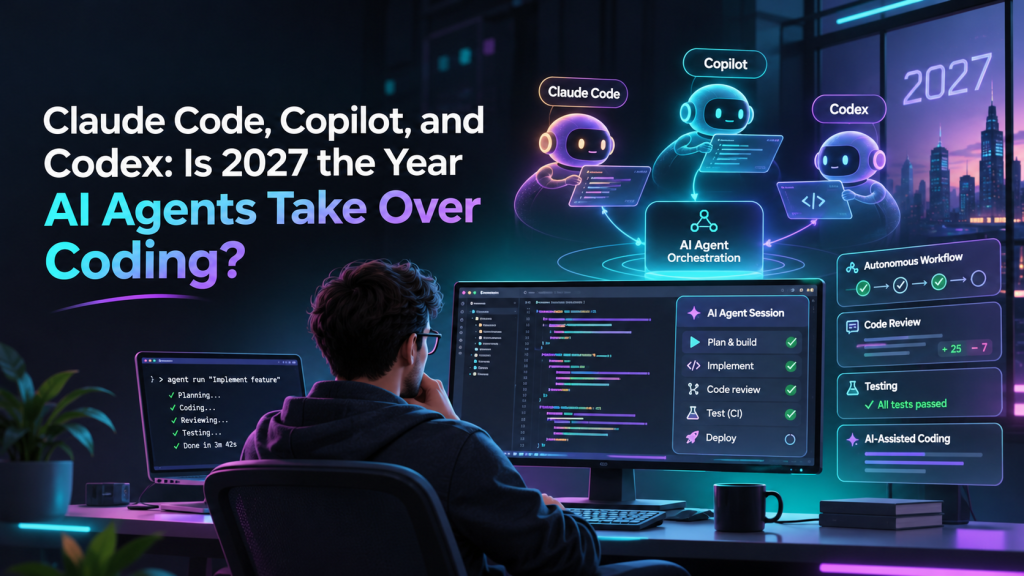
Claude Code, Copilot, and Codex: Is 2027 the Year AI Agents Take Over Coding?
Claude Code vs Copilot vs Codex is becoming an important comparison as artificial intelligence changes how developers build software. What started with autocomplete suggestions and basic code generation has evolved into tools capable of understanding projects, identifying bugs, running tests, and modifying multiple files.
As these AI coding assistants become more capable, a question emerges. Could 2027 be the year AI agents start handling most of the coding work?
Claude Code vs Copilot vs Codex: The Competition in 2026
The 2026 Stack Overflow Developer Survey found that 65.5% of respondents to its coding agent question reported using Claude Code, followed by GitHub Copilot at 58.7% and OpenAI Codex at 29.5%.
These figures reflect adoption among survey respondents rather than overall market share.
But software development involves much more than generating code. Understanding requirements, maintaining applications, and ensuring reliability are equally important.
This growing adoption also reflects a wider shift toward Generative AI Development, where AI is increasingly being integrated into business applications and development processes.
How Claude Code, Copilot, and Codex Compare
Claude Code helps developers work across existing codebases. It can explore projects, identify issues, implement changes, and assist with debugging.
GitHub Copilot has evolved beyond code suggestions. Its integration with GitHub allows coding agents to work on assigned tasks, propose changes, and create pull requests.
OpenAI Codex supports increasingly independent development workflows, including implementation, testing, code reviews, and coordinating multiple coding tasks.
Although their approaches differ, all three are moving toward reducing the manual effort involved in software development.
What Could AI Coding Look Like in 2027?
Imagine a developer receiving a request to add a feature to an existing application.
Instead of implementing everything manually, the developer assigns the task to an AI agent. The agent examines the codebase, identifies dependencies, makes changes, runs tests, and prepares the work for review.
Another agent could inspect the changes for security vulnerabilities or performance issues.
Such workflows could become more common in 2027, particularly as AI agents improve their ability to handle complex development tasks.
However, automation also brings questions about reliability and accountability. As discussed in Appzlogic’s article on AI-Powered Quality Engineering, intelligent testing can improve efficiency, but human expertise remains essential.
Will AI Coding Agents Replace Developers?
AI agents may handle more repetitive coding tasks, but that does not eliminate the need for software engineers.
Developers still need to understand business requirements, make architectural decisions, evaluate security risks, and ensure applications perform correctly.
AI may also change how quality assurance teams operate. Techniques such as automated test generation and defect prediction, explored in AI and Software Testing, could become increasingly important as development accelerates.
The role of developers may gradually shift toward reviewing solutions, managing AI agents, and solving problems that require deeper technical judgment.
Who Will Lead AI Coding in 2027?
The Claude Code vs Copilot vs Codex competition may ultimately depend on reliability, code quality, security, and integration with development environments.
Rather than choosing one platform, engineering teams might use different AI agents for different tasks.
2027 may not be the year AI replaces developers. But it could mark a significant change in how software is developed, tested, and maintained.
The real question is how much responsibility development teams will be comfortable handing over to AI.