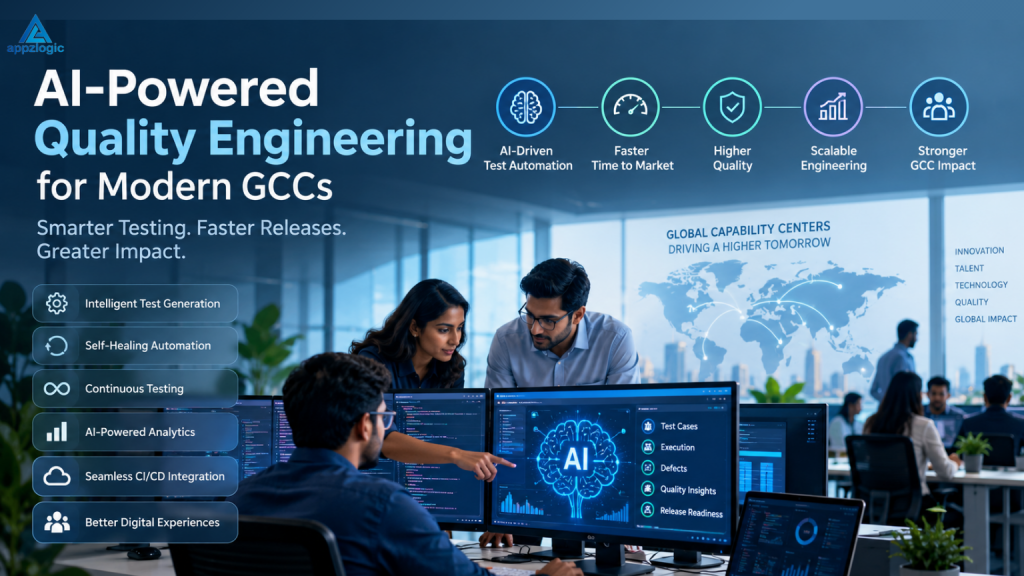
Global Capability Centers (GCCs) have shifted from focusing mainly on cost savings and support to becoming technology hubs. They now handle product engineering, digital transformation, cloud upgrades, AI, data platforms, cybersecurity, and innovation. With these expanded roles, GCCs need faster and more scalable ways to ensure software quality. Traditional testing often struggles to keep up with frequent releases, complex technology environments, distributed teams, and AI-driven applications. AI-powered Quality Engineering (QE) helps GCCs address these challenges. By using AI, automation, analytics, and continuous testing, GCCs can make quality an ongoing part of their business instead of treating it as a final step.
What Is AI-Powered Quality Engineering?
AI Quality Engineering uses AI and smart automation during software development to improve quality, speed up testing, release updates faster, and increase productivity.
Traditional quality assurance typically finds defects after development is finished. Quality Engineering, on the other hand, focuses on building quality into every stage, from requirements and development to deployment and production.
For GCCs managing multiple products, applications, geographies, and technology stacks, these capabilities can significantly improve scalability.
Why Quality Engineering Matters for Modern GCCs
Modern GCCs are increasingly accountable for delivering business-critical technology outcomes. They may manage applications supporting banking, healthcare, retail, manufacturing, SaaS, travel, and other global industries.
This creates several quality challenges.
1. Faster Release Cycles
Agile and DevOps practices have shortened development and release cycles. Organizations increasingly expect teams to deliver new features continuously. Testing cannot remain a bottleneck in this environment. AI-powered QE automates repetitive testing activities, accelerates regression cycles, and provides faster quality feedback to development teams.
2. Complex Application Ecosystems
Modern enterprise applications rarely operate in isolation.
A single business workflow might use web and mobile apps, APIs, databases, cloud platforms, third-party tools, identity systems, data pipelines, and AI or machine learning services. Testing all these connected systems by hand is difficult and time-consuming. AI-powered Quality Engineering helps GCC teams build broader, smarter test coverage for these complex setups.
3. Increasing Automation Demands
GCCs need to improve engineering productivity and manage larger technology portfolios. Traditional test automation often requires extensive scripting, maintenance, and specialized skills. With AI-assisted automation, teams spend less time on test creation and maintenance, so they can focus more on risk, strategy, and business outcomes.
4. Distributed Engineering Teams
Many GCCs have engineering, QA, product, and business teams worldwide. Keeping testing standards consistent across all these teams is challenging. A central Quality Engineering strategy, supported by smart automation, helps establish shared frameworks, reusable tools, clear guidelines, and quality measures across the organization.
How AI Is Transforming Quality Engineering
AI is changing the way testing is designed, executed, analyzed, and maintained.
AI-Based Test Case Generation
AI can review requirements, user stories, workflows, and application behavior to find possible test scenarios. Rather than creating every test case manually, teams can use AI to speed up test design and increase coverage. AI can suggest positive and negative test cases, boundary conditions, business rules, edge cases, and regression scenarios. Human expertise is still important, but AI saves time on repetitive test design.
Intelligent Test Prioritization
Large enterprise applications may have thousands of automated tests. Running every test after every change can increase execution time and infrastructure costs.
AI can consider code changes, past failures, app dependencies, defect patterns, business importance, and test history. This helps teams focus on tests most likely to find problems or affect key business processes.
Self-Healing Test Automation
A major challenge with traditional UI automation is keeping tests up to date. Small changes in the application, such as new element names, page layouts, or UI components, can cause automated tests to fail even if the main business function still works. AI-powered self-healing can detect these changes and update tests automatically, reducing maintenance work. This is especially useful for GCCs with many frequently changing applications.
Intelligent Defect and Failure Analysis
Test execution generates large volumes of data. AI can analyze test failures and identify patterns across logs, execution history, application behavior, and error messages. Instead of simply reporting that a test failed, intelligent analytics can help teams understand:
What failed?
Why did it fail?
Is it a new defect?
Is it a recurring issue?
Which application component is affected?
How critical is the failure?
This helps teams resolve defects more quickly and spend less time sorting through issues.
AI-Powered QE Across the Testing Lifecycle
Modern GCCs can apply AI across multiple layers of quality engineering.
This lets GCCs move from scattered testing efforts to a more connected, unified quality engineering system.
The Role of AI-Powered QE in DevOps and CI/CD
Quality Engineering becomes significantly more valuable when integrated into DevOps workflows. With continuous testing integrated into CI/CD pipelines, quality checks can happen automatically as applications move through development and deployment stages.
This way, organizations can spot quality issues sooner and lower the chance of defects making it to production. For GCCs with global products, ongoing quality checks also help teams release software faster without losing reliability.
Building an AI-First Quality Engineering Strategy for GCCs
Adopting AI-powered Quality Engineering involves more than choosing a new testing tool. GCCs need a clear plan that brings together technology, people, processes, and guidelines to build a quality engineering practice that can grow and last.
Step 1: Assess the Existing Quality Landscape
Begin by reviewing your current quality engineering setup, including testing methods, automation levels, applications, tools, CI/CD progress, defect trends, testing delays, and team skills. This assessment helps GCCs identify gaps, evaluate QE maturity, and determine where AI can have the most impact.
GCCs do not need to implement AI in every testing activity right away. Start by identifying high-value opportunities, such as high-volume regression testing, frequently changing applications, critical business workflows, API-heavy applications, large test suites, repetitive manual testing, and applications that require extensive maintenance. Focusing on these areas can help organizations achieve faster results and show the value of AI-powered QE.
Step 3: Establish a Unified QE Framework
Modern GCCs often support many applications, business units, and technology stacks, so consistent testing is essential. A unified Quality Engineering framework offers reusable test components, shared standards, automation rules, central reporting, clear controls, and consistent quality metrics. This creates a strong foundation for scaling AI-powered testing throughout the company.
Step 4: Integrate QE with CI/CD
Integrate quality into the software delivery pipeline instead of treating it as a final step before release. By linking automated testing with CI/CD workflows, GCCs can continuously check application quality, find issues earlier, provide faster feedback to development teams, and set up automated quality gates throughout the software development lifecycle.
Step 5: Introduce AI Gradually
GCCs can begin with AI-powered QE features such as AI test generation, smart test prioritization, self-healing automation, and automated failure analysis. As teams become more comfortable, they can gradually expand these tools to more areas of Quality Engineering, making software quality smarter, more scalable, and continuous.
Benefits of AI-Powered Quality Engineering for GCCs
A strong AI-powered Quality Engineering plan helps GCCs improve software quality, speed up delivery, and scale testing operations more efficiently.
Faster Time to Market
AI-powered automation reduces repetitive testing and speeds up test execution. This helps engineering teams check applications faster and release new features with greater confidence.
Higher Test Coverage
AI can review requirements, application behavior, and test data to identify additional scenarios and edge cases that traditional testing might miss, improving test coverage.
Reduced Test Maintenance
Self-healing and smart automation can adapt to some application changes automatically, so teams spend less time maintaining large, frequently changing automation suites.
Improved Engineering Productivity
When repetitive testing and analysis are automated, QA and engineering teams have more time for exploratory testing, risk assessments, problem-solving, and larger quality initiatives.
Greater Release Confidence
Continuous testing with smart analytics gives teams a clearer view of application quality. This helps them identify issues earlier and make better release decisions.
Scalable Testing Operations
AI-powered QE allows GCCs to expand testing across applications, teams, and business units while reducing the need for manual testing. This makes quality operations easier to scale.
Better Customer Experience
With better test coverage, fewer production bugs, more reliable applications, and faster fixes, GCCs can deliver more stable digital experiences and improve customer satisfaction.
Measuring the Success of AI-Powered QE
GCCs should measure the business and engineering results of AI-powered Quality Engineering, not just the number of automated tests. Important metrics include test coverage, regression execution time, defect leakage, test maintenance effort, defect detection and resolution time, release frequency, CI/CD effectiveness, production incidents, and overall engineering productivity. AI-powered quality dashboards can combine these metrics, giving leadership better visibility into application health, quality trends, and release readiness, while helping teams continuously improve their QE strategy.
AI-Powered QE and the Future of GCCs
GCCs are evolving alongside engineering. As they create and manage more advanced digital products, their quality engineering practices must also grow and adapt to new development methods.
Rather than just running set test cases, smart QE systems will start to understand how apps work, spot risks, create scenarios, pick test priorities, analyze failures, and keep learning from test and production data. This gives GCCs a chance to build AI-first engineering practices that are faster, scalable, reliable, and always improving.
Conclusion
Modern GCCs need to innovate quickly without sacrificing software quality. AI-powered Quality Engineering makes this possible by using AI, smart automation, continuous testing, analytics, and DevOps to speed up releases, increase test coverage, and reduce maintenance. Appzlogic helps GCCs build scalable QE with AI-driven test engineering, UI/API/database automation, regression testing, CI/CD integration, and smart test analytics. By making quality a constant, engineering-led focus, GCCs can release with greater confidence, work more efficiently, and deliver reliable digital products at scale. Ready to transform your Quality Engineering with AI? Partner with Appzlogic to build smart QE for your GCC.
AI-Powered Quality Engineering combines artificial intelligence, test automation, analytics, and continuous testing to improve software quality, accelerate testing, and identify defects earlier across the software development lifecycle.
AI can help GCCs automate test creation, prioritize high-risk tests, detect anomalies, analyze test results, reduce test maintenance, and improve overall testing efficiency and coverage.
AI can support UI, API, database, integration, regression, performance, security, and continuous testing, along with test case generation, defect analysis, and test prioritization.
Appzlogic helps GCCs build scalable QE capabilities through AI-assisted test engineering, test automation, UI/API/database testing, regression testing, CI/CD integration, self-healing automation, and intelligent test analytics.
GCCs can begin by assessing their existing testing landscape, identifying high-value automation opportunities, establishing a unified QE framework, integrating testing with CI/CD, and gradually introducing AI capabilities.
Blockchain has revolutionized the world in recent years, affecting everything from finance to supply chain management. Originally it was developed as the underlying technology for cryptocurrencies like Bitcoin, Blockchain’s applications have now expanded far beyond digital currencies. As reported by Fortune Business Insights, the global blockchain technology market was valued at USD 17.57 billion in […]
Generative AI Development: Transforming Businesses with Intelligent AI Solutions Artificial Intelligence is more than automation. Today, organizations use Generative AI Development to build smart applications that create content, write code, analyze documents, answer customer questions, and automate complex workflows. Healthcare, finance, retail, and manufacturing industries are using Custom Generative AI solutions to boost productivity, cut costs, and improve customer […]
Phishing attacks are one of the common cybersecurity threats nowadays. A person with great knowledge of tech can also get affected by these phishing traps. Phishing links may cause major risk to your personal data like your bank account, personal address, or even the important data of your company. But if you click on any […]