RAG Architecture Explained: How Enterprises Can Build Secure AI Knowledge Systems
Generative AI is quickly changing how companies find information, help employees, serve customers, and automate complex tasks. While Large Language Models (LLMs) are powerful, they do not automatically know about a company’s private documents, policies, databases, or up-to-date business knowledge. Retrieval-Augmented Generation (RAG) helps by linking AI models to enterprise knowledge sources, so AI can pull in relevant information before answering. This means RAG can base its responses on trusted company data, not just what the LLM learned during training. However, building a strong RAG pipeline system takes more than just connecting an LLM to a database. Companies need to think about data security, access control, retrieval quality, governance, scalability, monitoring, and AI security from the start. In this article, we’ll explain how RAG architecture works, its main parts, security risks, and what companies should keep in mind when building secure AI knowledge systems.
What Is Retrieval-Augmented Generation (RAG)?
RAG in AI is a method that links Large Language Models (LLMs) with trusted company knowledge. Rather than relying only on what the model learned during training, a RAG system searches approved data sources, finds relevant information, and provides it to the LLM as context. This helps the AI provide more accurate, reliable answers.
For example, if an employee wants to know about the latest travel policy, a RAG assistant can find the right policy document and answer based on that information. This makes RAG work for companies that deal with private, specialized, or often-changing information.
Why Enterprises Are Adopting RAG
Enterprise RAG creates huge amounts of information in documents, databases, apps, and collaboration tools, making it hard for employees to find what they need. RAG adds a conversational layer to company knowledge, so users can ask questions and get answers based on trusted business data. RAG use cases include building enterprise knowledge assistants, customer support tools, IT and HR helpers, research tools, healthcare apps, engineering assistants, and sales support solutions. The main benefit is that companies can use advanced Enterprise AI while making sure answers are based on their own up-to-date information.
How RAG Architecture Works
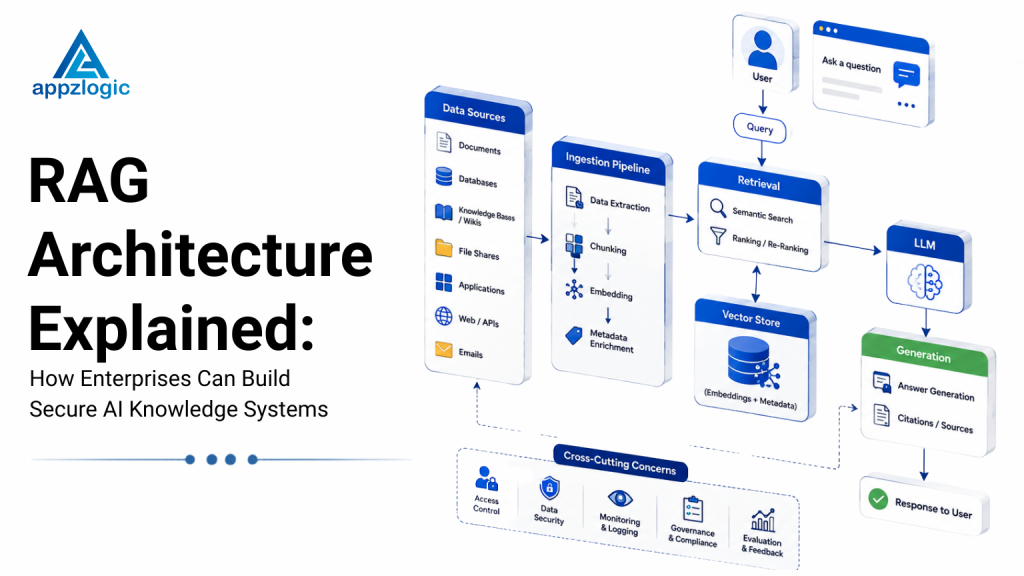
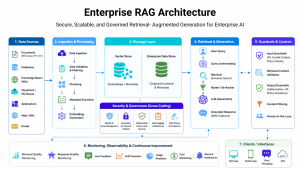
A production-ready RAG architecture usually works in two main steps: first, it gathers and organizes knowledge, then it handles questions, finds information, and generates answers. Here’s how it works:
- Enterprise Data Sources – RAG begins by connecting to approved enterprise knowledge bases, such as documents, PDFs, SharePoint, cloud storage, CRM and ERP systems, enterprise data integration, APIs, support tickets, and the RAG knowledge base. Companies should carefully choose what information to include and who can access it.
- Data Ingestion and Processing – RAG data ingestion gathers data from approved sources and prepares it for AI. This means extracting the content, removing duplicates or irrelevant details, marking sensitive data, and adding information like document ownership, department, access permissions, and the last update date.
- Document Chunking – Large documents are split into smaller, meaningful sections called chunks. This way, the RAG system can find and use only the most relevant parts instead of processing the whole document. Using the right chunking method can greatly improve how well the system finds information.
- Embedding Generation
Each chunk is turned into a set of numbers called an embedding. Embedding models help the system understand the meaning and context of the information, so it can find relevant content even if the user uses different words in their question. - Vector Database or Search Index – Vector Embeddings are saved in a vector database or search index, along with the original content, metadata, permissions, and source details. When someone asks a question, the system searches this index to find the most relevant information. Access controls are important to ensure users can only access what they are allowed to.
What Happens When a User Asks a Question?
After company knowledge is indexed, the RAG system follows a clear process to find the right information and create a secure, reliable answer:
- User Authentication – The system identifies the user and verifies their access permissions before processing the request.
- Query Processing – The system looks at the user’s question to understand what they are really asking. This can involve rewriting the question, determining intent, extracting key details, and applying security or metadata filters.
- Knowledge Retrieval – The system searches the enterprise knowledge index and retrieves the information most relevant to the user’s question.
- Authorization Filtering – The system checks retrieved information against the user’s permissions to ensure confidential or restricted content is not exposed.
- Context Construction – The approved information is organized into useful context that the LLM can use to answer the question.
- LLM Response Generation – The LLM uses system instructions, the user’s question, and the approved context to create a relevant and reliable answer.
- Validation & Guardrails – Before delivering the response, security controls can check for sensitive data, unsupported claims, unsafe content, and business-rule violations.
- Response with Citations – When needed, the final answer includes references to the original documents. This helps users check the information and trust the AI’s response.
Why Security Is Critical in Enterprise RAG
RAG systems connect AI to valuable company information, so security matters at every step. Here are the main risks companies need to watch for:
- Unauthorized Data Retrieval
Weak access controls can let unauthorized users see sensitive HR records, financial reports, contracts, or other confidential information. Companies should use RBAC, ABAC, document-level permissions, tenant isolation, and identity-aware retrieval to ensure users can only access what they are allowed to. - Prompt Injection
Attackers may use malicious instructions to manipulate AI behavior. In RAG systems, these instructions can also be hidden inside documents and retrieved as context, known as indirect prompt injection. Input validation, content scanning, prompt-injection detection, output validation, and restricted permissions can help reduce this risk. - Knowledge Base Poisoning
Incorrect, outdated, or malicious content added to the knowledge base can influence AI-generated answers. Organizations should control who can add content, what gets indexed, how information is validated, and how changes are monitored. - Sensitive Data Leakage
Company data stores may have personal information, financial data, customer details, intellectual property, credentials, and other confidential business info. Use data discovery, classification, filtering, masking, and access controls before sensitive data goes into the AI system. - Excessive AI Permissions
The risk is higher when RAG connects to AI agents that can call APIs, update records, or take business actions. Companies should use the principle of least privilege and require extra approval or human sign-off for sensitive or important actions.
A good RAG security model follows a simple rule: AI can find and suggest information, but security controls decide what it can access and what actions it can take.
Building a Secure Enterprise RAG System
Enterprises should build security, accuracy, and reliability into every layer of the Secure RAG architecture:
- Secure the Data Layer: Use data classification, sensitive-data detection, encryption, retention policies, and source validation to ensure only trusted information enters the RAG system.
- Enforce Identity-Aware Retrieval: Ensure users can only retrieve information they are authorized to access based on their roles and permissions.
- Protect the Vector Store: Apply encryption, authentication, network security, access logging, tenant isolation, and metadata-based authorization.
- Treat Retrieved Content as Untrusted: Validate retrieved information and detect potentially malicious, manipulated, or unreliable content before sending it to the LLM.
- Apply Input and Output Guardrails: Check user queries, retrieved content, and AI-generated responses for sensitive data, unsafe content, unsupported claims, and policy violations.
- Improve RAG Accuracy and Reliability: Continuously evaluate retrieval relevance, groundedness, answer quality, citation accuracy, response speed, and cost efficiency to improve overall RAG performance and user trust.
By following these steps, companies can build RAG security best practices that are secure, accurate, scalable, and ready for real-world use.
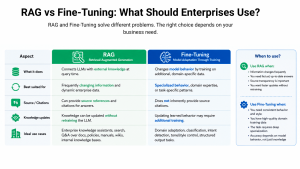 RAG and fine-tuning solve different problems. For many company knowledge projects, RAG is a good place to start because business information often changes. In some advanced cases, companies might use RAG together with fine-tuning, prompt engineering, and guardrails.
Common Enterprise RAG Mistakes to Avoid
- Indexing all data without proper sorting can add irrelevant, sensitive, or low-quality information to the RAG system.
- If you ignore access permissions, people who shouldn’t have access could see confidential information.
- Bad chunking methods can make it harder to find the right information and may leave out important context.
- Trusting all retrieved documents without checking can lead to answers based on old, wrong, or manipulated information.
- Relying only on system prompts for RAG security can create risks, since prompts should not replace proper authentication and authorization.
- Skipping regular evaluation can make it difficult to identify issues with retrieval quality, accuracy, and groundedness.
- Using outdated knowledge can result in confident but incorrect responses, making continuous knowledge updates essential.
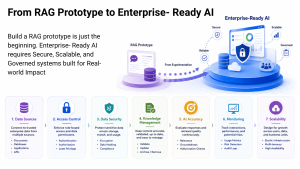
Turning a RAG prototype into a solution ready for the whole company takes more than just adding AI. Companies need to focus on data quality, access control, security, governance, accuracy, monitoring, and scalability. Addressing these areas early helps build RAG systems that are secure, reliable, and ready to scale across the business.
Conclusion
RAG is helping companies turn scattered business knowledge into smarter, more accessible, and useful AI experiences. But building an enterprise RAG solution is more than connecting documents to an LLM. It takes the right mix of trusted data, secure data handling, smart retrieval, access controls, AI guardrails, governance, monitoring, and ongoing evaluation. Build Secure Enterprise RAG Solutions with Appzlogic, helping to design and develop enterprise RAG solutions, Generative AI applications, AI copilots, enterprise knowledge assistants, and secure RAG architectures built for accuracy, security, governance, and scalability.
Frequently Asked Questions
RAG architecture combines information retrieval with Large Language Models (LLMs). It retrieves relevant information from trusted knowledge sources and provides it to the LLM as context, helping generate more accurate and grounded responses.
RAG typically follows a simple process: user query → knowledge retrieval → relevant context → LLM generation → grounded response. This allows the AI to answer questions using current and organization-specific information.
RAG allows enterprises to connect generative AI with their internal documents, databases, applications, and knowledge bases, making it useful for knowledge assistants, customer support copilots, HR assistants, and other enterprise AI applications.
Appzlogic can help organizations design, build, secure, and scale enterprise RAG and Generative AI solutions, covering data engineering, vector search, LLM integration, AI copilots, security, governance, cloud deployment, and optimization.
Common use cases include enterprise knowledge assistants, customer support copilots, IT helpdesk assistants, HR assistants, intelligent search, research tools, and domain-specific AI applications.