RAG vs Fine-Tuning: Which AI Approach Should Your Business Choose in 2026?
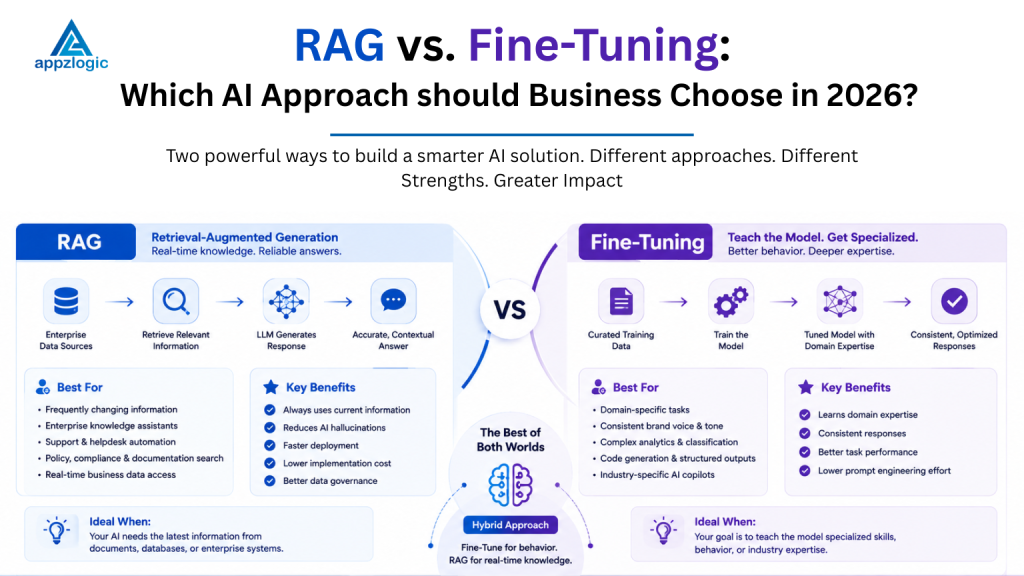
Artificial Intelligence is now much more than just chatbots and automation. It drives innovation in Enterprise AI and Generative AI. Companies use Large Language Models (LLMs) to search for company knowledge, automate tasks, create content, help developers, and personalize customer experiences. As more businesses adopt AI, a key decision is whether to use Retrieval-Augmented Generation (RAG) or Fine-Tuning LLMs. Both methods improve Generative AI, but they address different needs. Choosing the wrong one can increase costs, lower accuracy, and slow your return on investment. Knowing the strengths, weaknesses, and best uses for each approach is crucial for building scalable AI solutions. This guide will compare RAG and Fine-Tuning, explain how they work, outline their pros and cons, and help you choose the right AI strategy for your business.
What is Retrieval-Augmented Generation (RAG)?
Retrieval-Augmented Generation (RAG) is an Enterprise AI setup that lets Large Language Models (LLMs) pull in relevant information from outside sources before answering a question. Unlike older AI models that only use what they learned during training, RAG connects to enterprise knowledge bases, documents, PDFs, CRM systems, databases, APIs, SharePoint, Confluence, and other business tools. With vector databases and semantic search, RAG finds the most relevant information in real time and gives it to the LLM as extra context. This helps the AI give accurate, up-to-date answers and reduces mistakes. Because RAG always uses the latest company’s data, it is a strong choice for building scalable Enterprise AI applications and smart business assistants.
How RAG Works
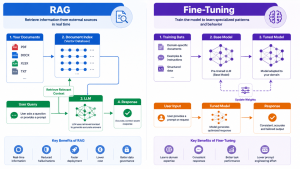
Retrieval-Augmented Generation (RAG) uses a step-by-step process to give accurate, context-aware answers. When someone asks a question, the system turns it into vector embeddings that capture its meaning. These are compared to a vector database with company knowledge, documents, manuals, and other data. The system finds the most relevant information and gives it to the Large Language Model (LLM) as extra context before it answers. By combining the user’s question with real-time company knowledge, RAG delivers accurate and reliable responses. This setup is used in AI-powered enterprise search, knowledge management systems, customer support chatbots, and AI assistants, so businesses always get answers based on the latest information.
What is Fine-Tuning?
Fine-Tuning means training a pre-trained Large Language Model (LLM) further using your company’s own data to make it work better for your specific needs. Instead of looking up outside information, a Fine-Tuned LLM learns from your industry terms, business processes, product details, writing style, customer interactions, and workflows. This extra training changes the model, so it gives answers that match your company’s expertise and communication style. Unlike RAG, which pulls in information as needed, Fine-Tuning updates the model itself. This makes it a good fit for custom AI development, Enterprise AI applications, and business cases that need deep knowledge of your field.
How Fine-Tuning Works
Fine-Tuning starts with a pre-trained Large Language Model (LLM) and trains it further using company-specific data. This data includes industry terms, customer chats, business workflows, technical documents, product info, and examples of the right response style. During training, the model learns to better handle specialized knowledge and business needs. After training, the Fine-Tuned AI model can do tasks like document classification, code generation, customer support, sentiment analysis, fraud detection and answer domain-specific questions without needing to look outside information. This makes Fine-Tuning a strong choice for companies that want specialized AI solutions with reliable and accurate results.
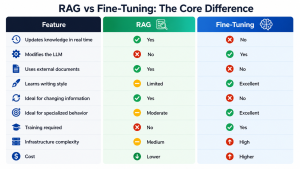
 RAG vs Fine-Tuning: The Core Difference

Benefits of RAG
- Always Uses Current Information – Retrieval-Augmented Generation (RAG) gets the latest information from company knowledge sources in real time. This means AI-powered applications always give accurate answers without needing to retrain the model every time business information changes.
- Reduces AI Hallucinations – By referencing trusted business documents and enterprise knowledge bases, RAG grounds responses in verified information instead of assumptions. This improves response accuracy, reliability, and user confidence.
- Faster Deployment – Organizations can deploy RAG to deliver answers based on verified information, not guesses. This makes responses more accurate and reliable and builds user trust.
- Lower Implementation Cost – With RAG, you update the knowledge source instead of retraining the AI model. This lowers maintenance costs and keeps your Enterprise AI application up to date.
- Better Data Governance – Sensitive company information stays safely stored in approved business systems, not inside the AI model. This improves security, compliance, and responsible AI use.
Benefits of Fine-Tuning
- Learns Domain Expertise – Fine-Tuning LLMs help AI learn industry-specific terms, workflows, and business processes. This makes it very useful for healthcare, finance, legal tech, manufacturing, and other specialized fields.
- Consistent Responses – A Fine-Tuned AI model gives answers in a consistent tone, style, and format that matches your company’s brand and customer experience standards.
- Better Task Performance – Fine-Tuning helps the model do better on specialized tasks like document classification, entity extraction, code generation, sentiment analysis, structured data creation, and industry-specific AI copilots.
- Lower Prompt Engineering Effort – Since the model learns the right behavior during training, it needs shorter prompts and gives more consistent, accurate, and reliable answers.
Limitations of RAG
RAG is flexible, but it also has some downsides:
- Depends on document quality
- Requires vector databases
- Retrieval accuracy impacts response quality
- Additional latency during document search
- More infrastructure components to manage
Limitations of Fine-Tuning
Fine-Tuning also comes with its own challenges:
- Expensive training process
- Requires high-quality labeled datasets
- Knowledge becomes outdated over time
- Retraining is needed whenever business information changes
- Longer implementation cycles
When Should You Choose RAG?
Retrieval-Augmented Generation (RAG) works best for companies that handle lots of changing information and need their AI to give accurate, up-to-date answers. It’s especially useful for enterprise knowledge management, AI chatbots, customer support, enterprise search, and smart AI assistants. RAG can also support employee help bots, technical document search, policy assistants, IT helpdesks, contract search, and product info portals. Since RAG pulls information from trusted sources for each question, users always get the latest business data without retraining the AI model. If your company wants better knowledge of access, fewer AI mistakes, and secure, scalable AI, RAG is often a top choice.
When Should You Choose Fine-Tuning?
Fine-Tuning is best when you want your AI model to learn specialized skills, deep knowledge, or a certain way of communicating, instead of just giving access to changing information. By training the model on domain-specific data, companies can create AI that understands special terms, workflows, and business needs. This works well for enterprise AI uses like medical help, legal document analysis, financial document sorting, fraud detection, code generation, writing assistants, smart AI agents, industry copilots, and automated quality checks. By tailoring the model to your tasks and business, Fine-Tuning gives more accurate, consistent, and predictable results. If your company needs specialized intelligence and top task performance, Fine-Tuning is a strong option for building scalable, focused AI.
Can Businesses Combine RAG and Fine-Tuning?
Yes, you can use both RAG and Fine-Tuning together for even better results. Many companies now use a Hybrid AI setup that combines Retrieval-Augmented Generation (RAG) with Fine-Tuning LLMs. This gives you accurate, real-time knowledge and keeps domain expertise. Fine-Tuning teaches the AI about your company’s knowledge, style, and tasks, while RAG lets it bring in the latest business info when needed. For example, a customer support AI can use Fine-Tuning to match your company’s voice and rules, and RAG to find the newest product guides, support articles, prices, or customer data. This way, the AI gives answers that are accurate, personal, and up to date. For businesses that want reliable and flexible AI, a hybrid approach often works best.
Industries Benefiting from RAG and Fine-Tuning
Healthcare
- Clinical knowledge assistants
- Medical documentation
- Patient support
- Research summarization
Banking & Financial Services
- Fraud detection
- Regulatory compliance
- Customer service
- Financial reporting
Retail & E-commerce
- Product recommendations
- Customer support
- Inventory assistance
- Personalized shopping experiences
Manufacturing
- Equipment maintenance
- SOP retrieval
- Quality assurance
- Production optimization
Education
- Intelligent tutoring
- Research assistance
- Personalized learning
- Knowledge management
Final Thoughts
Choosing between Retrieval-Augmented Generation (RAG) and Fine-Tuning LLMs depends on your business goals, data strategy, and how you plan to use AI. Many companies get the best results with a Hybrid AI setup that combines real-time knowledge retrieval and domain-specific training. As more businesses use Generative AI, picking up the right AI setup will help you get better returns, work more efficiently, and speed up digital transformation.
Appzlogic is a top AI consulting company that specializes in Enterprise AI Solutions, Custom AI Development, AI Agent Development, Retrieval-Augmented Generation (RAG), Fine-Tuning LLMs, Enterprise Knowledge Management, Vector Database Integration, LLM Optimization, AI Workflow Automation, and secure Generative AI Development for modern businesses.
Frequently Asked Questions
Retrieval-Augmented Generation (RAG) retrieves relevant information from external knowledge sources in real time, while Fine-Tuning trains a Large Language Model (LLM) on specialized datasets to modify its behavior and improve performance for specific tasks.
The best approach depends on your business requirements. RAG is better for frequently changing information and Enterprise Knowledge Management, while Fine-Tuning is ideal for Domain-specific AI, specialized tasks, and consistent model behavior.
Businesses should consider RAG when their Enterprise AI applications need access to current information from documents, databases, knowledge bases, or other enterprise systems. Common use cases include AI Chatbots, Enterprise Search, Customer Support AI, and AI Assistants.
Fine-Tuning is suitable when an organization needs an AI model to understand specialized terminology, follow specific instructions, maintain a consistent communication style, or perform well-defined tasks. It is commonly used for AI Agents, AI Copilots, Domain-specific AI, and custom Enterprise AI applications.
Appzlogic helps organizations design and implement Enterprise AI solutions, including RAG, Fine-Tuning, AI Agent Development, AI Copilots, Custom LLM Development, Enterprise Knowledge Management, Vector Database Integration, and AI Workflow Automation. The right architecture can be selected based on business objectives, data requirements, security needs, and scalability.