
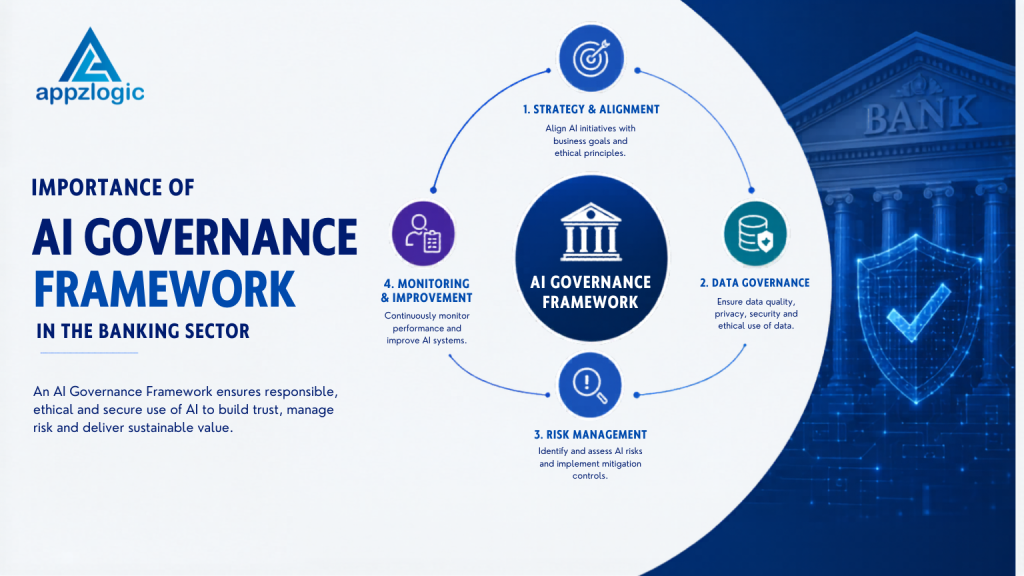
Importance of AI Governance Framework in the Banking Sector
Artificial Intelligence (AI) is rapidly changing banking operations. It supports fraud detection, risk assessment, customer service, and loan processing, helping banks work more efficiently and offer better experiences. However, as banks rely more on AI, concerns about transparency, fairness, security, compliance, and accountability are growing.
Banks need a solid AI Governance Framework to use AI responsibly and effectively. This framework outlines the policies, processes, and controls needed to manage AI systems throughout their lifecycle, ensuring regulatory compliance and supporting business goals.
What Is an AI Governance Framework?
An AI Governance Framework provides organizations with a clear way to manage the development, use, monitoring, and oversight of AI systems. It provides guidelines to ensure AI solutions are ethical, transparent, secure, compliant, and aligned with the organization’s goals.
AI governance in Banking builds trust in AI-driven decisions and lowers operational, regulatory, and reputational risks.
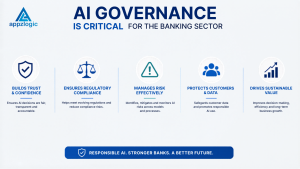
Why AI Governance Is Critical for the Banking Sector
-
Ensures Regulatory Compliance
Banks must follow strict regulations. As new AI guidelines and standards emerge worldwide, banks need to ensure their AI systems meet all legal and regulatory requirements.
An AI governance framework helps banks:
- Maintain compliance with financial regulations.
- Document AI decision-making processes
- Ensure auditability and accountability.
- Demonstrate responsible AI usage to regulators.
-
Reduces Bias and Promotes Fairness
AI models can pick up biases from past data, which can cause unfair results in areas like:
- Loan approvals
- Credit scoring
- Risk assessments
- Customer onboarding
AI governance helps banks identify bias, verify fairness, and maintain monitoring systems to ensure all customers are treated fairly.
-
Strengthens AI Risk Management
Banks rely on risk assessment models. Without good governance, AI systems can lead to operational, financial, and reputational problems.
A governance framework helps organizations:
- Identify AI-related risks early.
- Validate model performance
- Monitor model drift
- Establish risk mitigation strategies.
- Improve decision reliability
-
Enhances Transparency and Explainability
Many AI models operate like “black boxes,” making it hard to understand how they make decisions. In banking, it is important to explain decisions clearly when customers or regulators have questions.
AI governance ensures:
- Transparent AI processes
- Explainable decision-making
- Proper documentation of models
- Greater accountability across teams
-
Protects Customer Data and Privacy
Banks handle highly sensitive customer information. Since AI systems process a lot of personal and financial data, protecting privacy is extremely important.
An AI governance framework supports:
- Secure data handling practices
- Data access controls
- Privacy compliance
- Responsible use of customer information
- Protection against unauthorized access
-
Builds Customer Trust
Trust is central to banking. Customers expect banks to make decisions that are accurate, fair, and secure.
By implementing AI governance, banks can:
- Improve transparency
- Demonstrate responsible AI practices.
- Reduce discriminatory outcomes
- Increase confidence in AI-powered services.
-
Improves Model Performance and Reliability
AI models need regular checks and updates. When data patterns change over time, it can affect how accurate the models are.
Governance frameworks help ensure:
- Ongoing model validation
- Performance monitoring
- Regular updates and retraining
- Consistent business outcomes
- Reliable AI-driven decisions
Key Components of an AI Governance Framework for Banks
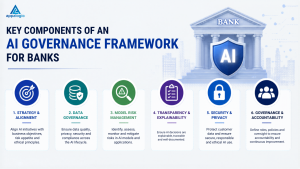
- AI policies and standards give clear rules for developing, deploying, and using AI throughout the organization. They help maintain consistency, support accountability, and ensure that AI use aligns with business goals, regulations, and responsible practices.
- AI Risk and Compliance Solutions helps organizations identify, assess, and mitigate AI-related risks while ensuring they comply with industry regulations and internal policies. This lowers operational, financial, and reputational risks.
- Model governance sets up controls for developing, testing, validating, approving, and monitoring AI models. This helps keep models accurate, reliable, and effective over time.
- Data governance makes sure the data used by AI systems is high-quality, secure, private, and trustworthy. It helps organizations stay compliant and improves the reliability of AI results.
- Responsible AI Adoption in Banking encourages fairness, transparency, accountability, and ethical decisions. They help reduce bias and build trust with customers, regulators, and other stakeholders.
- Security and cyber resilience measures protect AI systems from cyber threats, unauthorized access, data breaches, and model manipulation. Strong security controls help safeguard critical business and customer information.
- Continuous monitoring and auditing ensure AI systems perform as intended and remain compliant with regulations and governance requirements. Regular oversight helps identify issues early and supports ongoing improvement.
Challenges Banks Face Without AI Governance
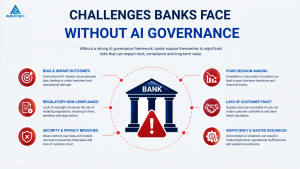
Organizations that deploy AI without proper governance may encounter:
- Failure to comply with AI regulations and industry standards can result in fines, legal issues, and increased regulatory scrutiny.
- Poorly managed AI Model Governance may lead to biased lending and credit decisions, resulting in unfair customer outcomes and compliance risks.
- Without regular monitoring, AI models can lose accuracy over time, resulting in unreliable decisions and increased business risk.
- Weak controls over data usage can lead to privacy breaches, regulatory violations, and loss of customer trust.
- AI-related failures, such as biased decisions or security incidents, can damage an organization’s reputation and customer confidence.
- Inadequate AI Security measures increase the risk of cyberattacks, model manipulation, data breaches, and unauthorized access.
- Lack of visibility into AI decision-making makes it difficult to explain outcomes, demonstrate compliance, and maintain accountability.
These issues can seriously damage customer trust and harm business performance.
Future of AI Governance in Banking
As AI Governance and Regulatory Compliance change worldwide, governance will become essential, not just a best practice. Banks that establish strong governance frameworks now will be better prepared to grow their AI projects responsibly and keep pace with regulations and trust expectations.
In the future, banking will rely heavily on AI systems that are trustworthy, secure, and easy to explain. Good governance will be crucial to making sure these technologies add value and keep risks low.
How Appzlogic Can Help
At Appzlogic, we support AI Governance for Financial Institutions, enabling robust AI adoption. Our team has experience in AI governance, risk management, cybersecurity, data governance, compliance, and enterprise AI projects. AI Governance Consulting helps organizations to create AI systems that are transparent, secure, and compliant. This helps drive innovation while maintaining trust, accountability, and compliance.
Conclusion
AI is changing banking by creating new ways to be efficient, offer personalized services, and grow. But to use AI well, banks need more than advanced technology—they also need strong governance. A framework helps banks manage risks, stay compliant, improve transparency, protect customer data, and build trust. As AI becomes a bigger part of Financial Services Technology, governance will be key to achieving responsible and lasting innovation.
Frequently Asked Questions
AI governance refers to the policies, controls, and processes used to manage AI systems responsibly, ensuring compliance, fairness, security, and accountability.
It helps banks reduce risk, meet regulatory requirements, improve transparency, prevent bias, and protect customer data.
By ensuring AI decisions are transparent, fair, explainable, and secure, banks can build greater confidence among customers and stakeholders.
Risks include biased decisions, regulatory non-compliance, privacy violations, cybersecurity threats, and reputational damage.
It provides documentation, oversight, monitoring, and accountability mechanisms that help banks meet evolving AI and financial regulations.