Traditional Chatbot vs AI Chatbot vs AI Agent: What’s the Difference?

Many businesses use AI-powered automation to enhance customer experience, reduce costs, and operate more efficiently. However, terms such as traditional chatbot, AI chatbot, and AI agent are often used interchangeably, making it hard for organizations to distinguish among them. 

All three options help automate conversations and support users, but they differ in what they can do and how much they can help your business. We’ll break down the main differences between traditional chatbots, AI chatbots, and AI agents to help businesses choose the right AI automation solution.  

What is a Traditional Chatbot? 

traditional chatbot follows set rules and responds to specific commands or scripts. It relies on decision trees, keywords, and fixed workflows. 

These chatbots can only answer questions they have been programmed to handle. 

For example: 

  • User: “What are your business hours?” 
  • Bot: “Our business hours are 9 AM to 6 PM.” 

If a user asks something outside its script, the chatbot might not give the right answer. 

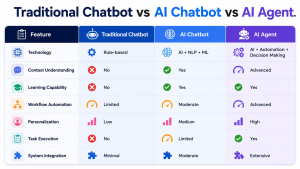
Traditional chatbots have rule-based responses, recognize keywords, follow set workflows, have limited conversation skills, and do not understand context. 

Their advantages include easy setup, low-cost basic support, and suitability for FAQs and simple tasks. 

However, they cannot understand intent, do not learn over time, struggle with complex questions, and offer little personalization. 

Traditional chatbots are best for businesses seeking simple customer service automation. 

What is an AI Chatbot? 

An AI chatbot is a more advanced system that uses artificial intelligence, natural language processing (NLP), and machine learning (ML) to engage in conversation with users. 

Unlike traditional chatbots, AI chatbots can understand context, intent, and the flow of conversations. They offer more natural interactions and get better as they learn from experience. 

For example: 

  • User: “I forgot my password and can’t log in.” 
  • AI Chatbot: “I can help you reset your password. Would you like me to send a reset link to your registered email?” 

AI chatbots can recognize different ways people speak, handle spelling mistakes, and adapt to the tone of a conversation. 

AI chatbots understand natural language, maintain context, recognize intent, handle multi-turn conversations, and learn and improve over time. 

Their advantages are better customer experiences, more human-like conversations, handling complex questions, scalable support, and personalized support. 

Limitations include the need for training data, higher setup costs, and, sometimes, the need for human assistance with advanced tasks. 

AI chatbot solutions are used in customer service, healthcare, banking, eCommerce, and SaaS platforms. 

What is an AI Agent? 

An AI agent is the most advanced type of enterprise AI automation. It can interact with users, take actions, make decisions, automate workflows, and connect to different systems on its own. 

AI agents combine conversational AI with reasoning, memory, automation, and the ability to work with other systems. 

For example: 

  • User: “Book a demo meeting for next Tuesday and send the details to my email.” 
  • AI Agent: Checks calendar availability, Schedules the meeting, Sends email confirmation, and Updates CRM automation 

Unlike chatbots, AI agents can complete tasks on their own instead of just answering questions. 

AI agents can make decisions independently, automate workflows, connect to APIs and CRMs, retain context, handle multi-step tasks, and process data in real time. 

Their advantages include full automation, reduced manual work, faster business operations, more informed decision-making, and a highly personalized customer experience. 

Limitations include complex setups, the need for strong data and system integration, and higher infrastructure costs.  

AI agents for business automation are quickly becoming the future of smart business automation. 
Which Solution Should Your Business Choose? 

The best AI automation solution depends on your business goals, your customers’ expectations, and the complexity of your operations. 

Choose a Traditional Chatbot If: 

  • You only need FAQ automation. 
  • Your workflows are simple. 
  • You have a limited budget. 
  • You require basic customer interaction. 

Choose an AI Chatbot If: 

  • You want intelligent customer support. 
  • You need personalized interactions. 
  • You receive high volumes of customer queries. 
  • You want better engagement and faster resolutions. 

Choose an AI Agent If: 

  • You want complete workflow automation. 
  • Your business relies on multiple software systems. 
  • You want AI-powered operational efficiency. 
  • You need autonomous task execution. 

Industries Benefiting from AI Agents and AI Chatbots 
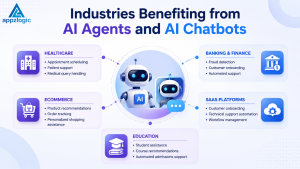
  • Healthcare—Appointment scheduling, Patient support, and Medical query handling 
  • Banking & Finance—Fraud detection, Customer onboarding, and automated support 
  • eCommerce– Product recommendations, Order tracking, and Personalized shopping assistance 
  • SaaS Platforms—Customer onboarding, Technical support automation, and workflow management 
  • Education—Student assistance, Course recommendations, and Automated admissions support 

The Future of Conversational AI 

  • Switching from traditional chatbots to AI agents is a big step in digital transformation. 
  • Businesses now need smart systems that can understand users, make decisions, automate tasks, boost productivity, and deliver personalized experiences. 
  • AI agents are expected to be the next generation of enterprise automation, helping businesses work smarter, faster, and more efficiently. 

Final Thoughts 

Traditional chatbots helped businesses automate basic conversations. AI chatbots improved customer engagement with smarter interactions. Now, AI agents are changing industries by combining conversation, automation, and decision-making into a powerful system. The right solution depends on your business needs, growth plans, and your customers’ expectations. Businesses that invest in AI-powered automation now will have a strong advantage over competitors in the future. Contact us to create your own AI chatbot or AI agent solution for your business. 

Request a demo

Frequently Asked Questions

A traditional chatbot works on predefined rules and scripted responses, while an AI chatbot uses Artificial Intelligence (AI), Natural Language Processing (NLP), and Machine Learning (ML) to understand user intent and provide more human-like conversations.

It depends on your business requirements. AI chatbots are ideal for intelligent customer support and engagement, while AI agents are best for complete workflow automation and autonomous task execution.

Yes. AI chatbots use machine learning algorithms to improve responses over time by analyzing customer interactions and conversation patterns.

AI chatbot implementation costs vary depending on features, integrations, and complexity. They generally cost more than traditional chatbots but provide better scalability and customer engagement.

The future of conversational AI lies in intelligent AI agents capable of autonomous decision-making, workflow automation, personalized interactions, and real-time business support.
Cloud Security Practices

Best Practices for Cloud Security in 2025

Cloud computing has revolutionized the business operations by providing scalable, secure, and portable solutions. However, with great benefits come significant risks. As Cyber Threats evolve, securing cloud environments has become more critical than ever. Here are the best practices for cloud security in 2025 to help organizations safeguard their data and infrastructure.  Why Cloud Security […]

How Automation Testing with AI Helping In QA

How Automation Testing with AI Improves Speed, Accuracy & ROI in QA

Quality assurance (QA) needs to be done fast, smarter, and more cost-effective. Traditional manual testing methods fail to keep up with the speed of Agile and DevOps pipelines. AI-powered test automation is changing the game when it comes to software testing. It is genuinely transforming how testing gets done. By speeding up the process, cutting […]

Finance processes involve numerous tasks, multiple approvals, and strict compliance requirements, making them inherently complex and time-consuming. Organizations need a way to ensure that workflows are consistent, efficient, and transparent across departments while reducing errors and delays. Camunda BPM offers a powerful solution by enabling businesses to design, automate, and manage workflows using BPMN business process model and notation. With Camunda, finance teams can visualize processes clearly, implement automated tasks, and integrate workflows seamlessly with existing systems, improving overall efficiency and accuracy. By providing a structured framework for managing transactions, compliance checks, customer interactions, and reporting, Camunda simplifies the execution of finance processes, ensuring operations remain reliable, accountable, and easy to monitor. What is Camunda BPM? Camunda BPM is an open-source BPM platform built to execute and automate workflows created with BPMN. It enables organizations to design processes clearly, automate repetitive tasks, and manage complex workflows efficiently. Unlike traditional systems, Camunda offers flexibility, allowing businesses to adapt processes as their needs evolve without being tied to proprietary solutions. The platform is especially valuable for financial institutions because it supports critical operations such as compliance workflows, transaction monitoring, customer support processes, and regulatory reporting. Its seamless integration with existing systems through the Camunda API ensures that workflows operate smoothly across different departments and applications. By using Camunda BPM, organizations gain better control, transparency, and efficiency in their business processes, while also reducing risks and ensuring consistent performance across all operations. What is a BPMN Diagram? A BPMN diagram is the visual output of business process modeling. It shows tasks, events, and BPMN gateways that represent decision points in a process. For finance processes, these diagrams can illustrate how a loan request moves from submission to approval or rejection. Using a BPM platform like Camunda, financial organizations can move from static diagrams to executable workflows that directly integrate with systems and applications. What is BPMN in Business Analysis? Business analysts use BPMN because it provides a shared language for finance teams and IT departments, reducing miscommunication and ensuring everyone understands the same workflow. BPMN diagrams visually represent processes in a structured way, showing tasks, events, and decision points clearly. This makes it easier to identify inefficiencies, enforce compliance requirements, and uncover opportunities for automation using BPM automation tools. Beyond mapping processes, BPMN helps finance teams document workflows for audits, training, and continuous improvement. Analysts can track how tasks are performed, highlight repetitive steps that could be automated, and ensure that critical controls are in place. By using BPMN, organizations can align operational execution with strategic goals, monitor performance, and quickly adapt workflows as regulations or business priorities change. This approach supports transparency, accountability, and efficiency across all finance processes, helping teams deliver consistent results. Camunda Modeler The Camunda Modeler is a desktop application that allows users to design workflows using BPMN 2.0. When finance teams ask how to use Camunda Modeler, the answer is simple: it offers a drag-and-drop interface where you can design processes with tasks, events, and gateways.For instance, a financial compliance officer can use Camunda Modeler to build a process diagram for anti-money laundering checks. Once designed, the workflow can be deployed into the Camunda BPM engine, ensuring the process runs automatically. BPM Automation Tools in Finance Financial services require reliable BPM automation tools to handle high volumes of repetitive tasks. Camunda’s workflow automation ensures processes like payment reconciliation or fraud detection run consistently and accurately. Unlike traditional tools, Camunda does not act as a black box. Teams can monitor workflows in real time, adjust business rules, and continuously improve their models. This transparency is especially valuable in regulated industries where auditability is crucial. Camunda Workflow for Finance The Camunda workflow engine is the heart of execution. Once a business process model is created in the Modeler, the workflow engine ensures tasks are executed in order, data is routed correctly, and escalations happen on time. Camunda workflow is widely applied in loan application approvals, fraud detection checks, regulatory compliance reporting, and customer onboarding verification. With BPMN gateways, workflows can branch into different paths based on conditions, such as risk level or credit score. Camunda API for Integration One of the most powerful aspects of Camunda is its API design, which ensures that organizations can seamlessly connect their workflows with existing systems and applications. The Camunda API makes it possible for financial institutions to bring together multiple platforms, ranging from customer management systems and payment gateways to compliance and reporting solutions, into a single, unified process. This level of connectivity ensures that data moves smoothly across different departments, reducing silos and enhancing collaboration. We also use the Camunda API to help financial organizations to build integrated environments where workflows are not limited to a single tool but interact effortlessly with core banking platforms, regulatory systems, and enterprise applications. This approach provides finance teams with greater flexibility, visibility, and control, ensuring that their operations remain accurate. Business Process Modeling and Compliance Financial institutions operate under strict regulations, and ensuring compliance is a critical part of every workflow. Through business process modeling, organizations can embed compliance checks directly into their processes, making them an integral part of day-to-day operations rather than separate tasks. Using BPMN 2.0, rules and regulations are represented clearly and become part of the executable workflow, which ensures that every step follows established guidelines. This approach not only helps teams maintain accuracy and consistency but also provides transparency, making it easier to track processes and demonstrate compliance during audits. By integrating compliance into the workflow itself, financial organizations reduce the risk of errors or oversights, improve accountability, and create a system where regulatory requirements are consistently met across all operations. Camunda Enterprise Pricing When organizations consider adopting Camunda at an enterprise level, understanding Camunda enterprise pricing becomes important. While the open-source version provides robust workflow automation, the enterprise edition adds advanced capabilities such as dedicated support, enhanced monitoring tools, and greater scalability for large-scale operations. For financial institutions with high transaction volumes, complex compliance requirements, and critical regulatory obligations, the enterprise edition ensures that workflows remain reliable, secure, and efficient. By choosing enterprise features, organizations can manage processes confidently and maintain stability across all finance operations. Advantages of Camunda BPM Platform in Finance The BPM platform provided by Camunda offers multiple advantages for finance. Using business process model and notation, workflows become standardized across teams, ensuring clarity and consistency. The platform also provides transparency because workflows can be monitored in real time. Its flexibility is a major benefit as well, since through the Camunda API it integrates smoothly with core banking and compliance systems. Efficiency is improved as automated workflows reduce manual errors and delays, and scalability ensures that Camunda can serve both small financial teams and global banking organizations. How Finance Teams Use Camunda? Finance teams apply Camunda in multiple ways. Transaction approvals are automated with BPMN gateways, customer onboarding processes are enhanced through automated KYC checks, and compliance monitoring is handled by rule-based workflows.By combining business process modeling with automation, Camunda helps finance teams reduce costs while improving customer experiences. Conclusion Camunda BPM offers financial institutions a practical and efficient way to manage complex workflows, enforce compliance, and automate critical tasks. By using BPMN 2.0, organizations can clearly visualize processes, integrate systems through the Camunda API, and ensure that operations run smoothly and reliably. With tools like Camunda Modeler and BPM automation tools, finance teams gain transparency, control, and the ability to continuously improve workflows. At Appzlogic, we support organizations in including these capabilities and helping teams to implement Camunda effectively and ensuring that finance processes are not only automated but also aligned with operational and compliance requirements.

How Does Camunda Make BPMN Easier for Finance Processes?

Finance processes involve numerous tasks, multiple approvals, and strict compliance requirements, making them inherently complex and time-consuming. Organizations need a way to ensure that workflows are consistent, efficient, and transparent across departments while reducing errors and delays. Camunda BPM offers a powerful solution by enabling businesses to design, automate, and manage workflows using BPMN business […]