Appzlogic Logo

What Is a Global Capability Center (GCC)?

A Global Capability Center (GCC) is a unit an organization sets up to support its global operations through technology, skilled talent, innovation, and business know-how. In the past, these centers were mainly called captive centers or offshore development centers and focused on saving costs. Today, modern Global Capability Centers act as innovation hubs, helping organizations create digital products, modernize operations, strengthen cybersecurity, analyze data, and drive digital transformation across the business.

What Does a Global Capability Center Do?
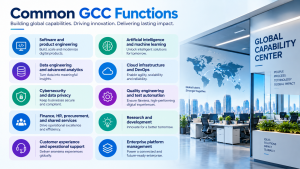
A GCC brings together skilled professionals, technology, and business processes in one place. It works with global teams to support different business functions.
A GCC’s work depends on the organization’s industry, business goals, and level of digital maturity.

How Have GCCs Evolved?

The role of GCCs has changed significantly over time.

Traditional GCC Model

Earlier GCCs mainly handled routine and back-office tasks. Their main goals were to reduce costs, improve efficiency, and offer 24/7 support.

Modern GCC Model

Modern GCCs take on key business and technology roles. They build enterprise platforms, develop AI solutions, manage important operations, improve customer experiences, and support business growth.

AI-Native GCC Model

AI-native GCCs use artificial intelligence in engineering, operations, decision-making, and customer service. They use generative AI, automation, predictive analytics, and smart agents to speed up and scale business processes.
This change has turned GCCs from simple delivery centers into strategic partners for global businesses.

Core Capabilities of a Modern GCC

1. Digital and Product Engineering

GCC teams design, build, test, and maintain digital products for users worldwide. They might update applications, develop mobile apps, build APIs, create microservices, and connect different platforms.

2. AI, Data, and Analytics

Modern GCCs help companies use data better through data engineering, business intelligence, machine learning, generative AI, and predictive analytics. These abilities help organizations make smarter decisions and automate work.

3. Cloud and DevOps

GCC cloud transformation includes cloud migration, infrastructure modernization, DevSecOps, continuous integration and delivery, monitoring, and platform engineering. This allows organizations to launch applications faster and keep them reliable.

4. Cybersecurity and Privacy

GCCs protect company applications, networks, user identities, and sensitive data. They handle threat monitoring, vulnerability scanning, application security, incident response, regulatory compliance, and data privacy.

5. Quality Engineering

GCC quality engineering teams use intelligent test automation, performance testing, security testing, and AI-powered testing to improve software quality. They help organizations lower release risks and deliver reliable digital experiences.

6. Enterprise Platforms

GCCs set up and manage platforms such as Salesforce, ServiceNow, SAP, Workday, MuleSoft, and Microsoft Dynamics. They also help automate business processes, connect workflows, and boost platform performance.

Why Are Organizations Investing in GCCs?

  • Specialized Talent: Access global expertise across AI, data, cloud, cybersecurity, and engineering.
  • Faster Development: Accelerate product development and time to market.
  • Operational Efficiency: Streamline processes and improve productivity.
  • IP Control: Retain greater ownership of technology and intellectual property.
  • Data Security: Strengthen security, privacy, compliance, and governance.
  • Process Standardization: Create consistent operations across global locations.
  • Business Continuity: Improve operational resilience and round-the-clock support.
  • Technology Adoption: Accelerate AI, automation, and emerging technology adoption.
  • Business Alignment: Connect technology teams more closely with strategic priorities.
  • Long-Term Innovation: Build sustainable capabilities for continuous transformation.

Why India Is a Leading GCC Destination
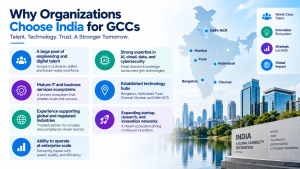
India is a top destination for Global Capability Centers because it has a strong technology ecosystem, deep digital expertise, and a large pool of skilled professionals. The growing GCC ecosystem in India helps global companies access specialized talent, scalable delivery, and technology innovation.
GCCs in India now support a wide range of industries, including banking, healthcare, retail, manufacturing, travel, publishing, telecommunications, and software technology.

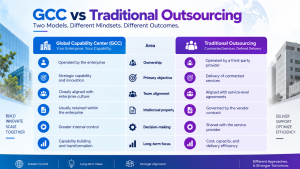
GCC vs Traditional Outsourcing

GCCs and outsourcing providers can work together, but their operating models are different.
Many companies use a hybrid partner-led approach. Their GCC keeps strategic control, while a GCC technology partner provides specialized talent, engineering skills, platforms, and delivery support.

Challenges in Building and Scaling a GCC

Building a successful GCC takes more than choosing a location and hiring staff. Organizations may face challenges such as:
  • Specialized Talent Shortage: Finding professionals with expertise in AI, data, cloud, cybersecurity, and emerging technologies can be difficult.
  • Intense Talent Competition: High demand for experienced professionals can increase hiring costs and extend recruitment timelines.
  • Global and Local Alignment: Differences in priorities, communication, culture, and time zones can affect collaboration.
  • Unclear Governance: Undefined ownership, decision-making authority, and accountability can slow operations and delivery.
  • Legacy Technology: Outdated applications and disconnected systems can restrict scalability, integration, and innovation.
  • Security and Compliance Risks: GCCs must protect sensitive data while meeting global and local regulatory requirements.
  • Limited Innovation Culture: A delivery-focused mindset can prevent teams from experimenting and developing strategic solutions.
  • Employee Retention: Limited career growth and leadership opportunities can make it difficult to retain skilled professionals.
  • Unclear Business Outcomes: Without measurable KPIs, organizations may struggle to demonstrate the GCC’s strategic value.
Organizations can overcome these challenges with a clear GCC operating model, strong leadership, effective workforce planning, modern technology platforms, and an experienced GCC transformation partner.

How to Establish and Scale a Successful GCC

Organizations that want to build or grow a GCC should focus on these areas:
  1. Define the strategic purpose: Identify whether the GCC will focus on engineering, operations, innovation, analytics, shared services, or a combination of capabilities.
  2. Select the right operating model: Choose between a fully owned center, Build-Operate-Transfer (BOT) model, joint venture, or hybrid partner-led approach.
  3. Develop a talent strategy: Plan recruitment, onboarding, learning, leadership development, and employee retention.
  4. Create strong governance: Define responsibilities, performance indicators, security controls, and communication structures.
  5. Build a scalable technology foundation: Use cloud platforms, automation, APIs, data platforms, cybersecurity tools, and modern engineering practices.
  6. Measure business value: Track outcomes such as release speed, product quality, operational efficiency, innovation, cost optimization, and customer satisfaction.
  7. Promote continuous innovation: Encourage experimentation, reusable solutions, research, and collaboration across global teams.

The Future of Global Capability Centers

Artificial intelligence, smart automation, data-driven operations, and global engineering teamwork will shape the future of GCCs.
Next-generation GCCs will increasingly:
  • Develop Enterprise AI and Generative AI Solutions: Build scalable AI solutions that boost productivity, improve customer experiences, and strengthen decision-making.
  • Deploy Intelligent Agents: Use AI agents to automate complex workflows and coordinate tasks across business functions.
  • Create Global Digital Products: Design, develop, and manage digital platforms that serve customers and employees worldwide.
  • Strengthen Cybersecurity and Privacy: Protect enterprise systems and sensitive data through advanced security, governance, and compliance practices.
  • Build Reusable Technology Accelerators: Create frameworks, platforms, and automation tools that accelerate development across the organization.
  • Enable Real-Time Decision-Making: Turn enterprise data into timely insights that support faster, more informed business decisions.
  • Lead Research and Innovation: Test emerging technologies, develop proofs of concept, and convert successful ideas into scalable solutions.
  • Own Measurable Business Outcomes: Take greater responsibility for revenue growth, operational efficiency, customer satisfaction, and product performance.
As GCCs take on more responsibilities, they will become even more important for business competitiveness, innovation, and long-term resilience.

Final Thoughts

A Global Capability Center is no longer just an offshore support center. It has become a key part of the business, bringing together specialized talent, modern technology, and innovation. As a GCC technology partner, Appzlogic helps organizations set up, grow, and modernize their GCCs with AI and data engineering, product development, quality engineering, cybersecurity, cloud, enterprise platforms, and flexible staff augmentation services. With our expertise and global reach, we help GCCs speed up digital transformation, improve performance, and build capabilities for long-term growth.

Request a demo

Frequently Asked Questions

A Global Capability Center (GCC) is a strategic unit established by an organization to support global operations through technology, specialized talent, business expertise, and innovation.

A GCC can provide software engineering, AI and data services, cloud and DevOps, cybersecurity, quality engineering, enterprise platform management, analytics, and shared business services.

As a GCC technology partner, Appzlogic supports organizations with AI and data engineering, product development, quality engineering, cybersecurity, cloud and DevOps, enterprise platforms, staff augmentation, and dedicated engineering teams.

Common challenges include talent shortages, employee retention, global and local team alignment, unclear governance, legacy technology, cybersecurity risks, and difficulty measuring business outcomes.

India offers a large technology talent pool, mature digital infrastructure, strong expertise in AI, cloud, data, and cybersecurity, and an established ecosystem of technology and innovation hubs.

What Is a Global Capability Center (GCC)?

A Global Capability Center (GCC) is a unit an organization sets up to support its global operations through technology, skilled talent, innovation, and business know-how. In the past, these centers were mainly called captive centers or offshore development centers and focused on saving costs. Today, modern Global Capability Centers act as innovation hubs, helping organizations […]

Artificial Intelligence in machine learning and software testing

Leveraging AI in Machine Learning and Software Testing

Artificial Intelligence provides higher efficiency in workflows. AI can be used in accurate software testing. It reduces the manual approach and provides quality results. Among the areas witnessing transformative impacts are machine learning (ML) and software testing. Leveraging AI in software testing has unlocked new possibilities for enhancing Quality Assurance, improving testing efficiency, and creating intelligent […]

What steps take after clicking on a suspicious link?

What to Do If You Click on a Phishing Link?

Phishing attacks are one of the common cybersecurity threats nowadays. A person with great knowledge of tech can also get affected by these phishing traps. Phishing links may cause major risk to your personal data like your bank account, personal address, or even the important data of your company. But if you click on any […]

How do we maintain data accuracy during ETL

How Can We Ensure Content Accuracy With ETL?

ETL stands for Extract, Transform, Load. It is a process which is used in data management to collect information about data from different sources, change it into a useful format, and then move it to a storage system like a database or data warehouse. ETL helps businesses make sense of large amounts of data by […]