Data Engineering In 2025: Top Trends Every Business Owner Must Know
Data Engineering continues to play an important role in modern businesses by enabling the management and utilization of vast amounts of data. As we move into 2025 where AI is growing and several key trends are reshaping the field, making data management more efficient and intelligent. These trends derived from technological advancements, regulatory shifts, and the growing need for real-time data insights. Businesses that adapt to these changes will gain a competitive edge by leveraging data more effectively.
Understanding Data Engineering
Data engineering is a constructing system for aggregating, storing, and analyzing data at scale. It provides the backbone for organizations to extract meaningful insights from massive datasets. The scope of Data Engineering extends across various industries, enabling companies to transform raw data into actionable intelligence. From social media engagement metrics to operational analytics, data engineers ensure that information is well-structured, high-quality, and accessible for analysis.
The Importance of Data Engineering

The significance of data engineering extends beyond just handling data. It ensures that enterprises can harness the power of structured and unstructured data effectively. Businesses and organizations generate vast amounts of data daily, without proper engineering, this data remains untapped, creating inefficiencies and missed opportunities.
Data engineers enable businesses to integrate various data sources, improve data accuracy, and provide scalable storage solutions. This structured approach helps companies monitor key performance indicators, predict trends, and optimize their workflows. Moreover, as businesses rely more on real-time analytics, data engineering ensures that insights are available on demand, enabling more agile responses to market changes.
Key Trends Shaping Data Engineering in 2025

1. Real-Time Data Processing Becomes the Norm
Businesses relied heavily on batch processing, where data was collected and processed at scheduled intervals. However real-time data processing has become the new standard. Organizations across industries now demand immediate insights to enhance customer experience, optimize supply chains, and mitigate risks. With the advent of advanced streaming technologies such as Apache Kafka, Apache Flink, and cloud-based streaming solutions, enterprises can process data in real time, allowing them to make instant decisions.
2. AI and Automation Drive Data Engineering
Artificial intelligence (AI) and automation have significantly influenced data engineering practices, making them more efficient and scalable. AI-driven tools now automate data integration, data cleansing, and pipeline optimization, reducing manual intervention and minimizing errors. Machine learning models further enhance data governance by identifying malware, predicting failures, and streamlining operations.
3. DataOps Gains Traction
Inspired by the principles of DevOps, DataOps is an emerging methodology that emphasizes agility, collaboration, and automation in data engineering. Organizations are increasingly adopting DataOps to streamline the development and deployment of data pipelines, ensuring that data workflows are continuously integrated and deployed (CI/CD)
4. The Rise of the Data Lakehouse
The hybrid concept of a data Lakehouse is transforming data storage and management. Traditionally, companies relied on either data warehouses for structured data or data lakes for unstructured data. However, a Data Lakehouse combines the best of both worlds, offering the scalability of a data lake with the structured governance of a data warehouse. This model enhances performance by allowing organizations to query large datasets efficiently while maintaining compliance and governance.
5. Privacy and Compliance Take Center Stage
With growing concerns over data privacy and stringent regulations such as GDPR, CCPA, and new data sovereignty laws, businesses are prioritizing data security and compliance. In 2025, companies are increasingly adopting technologies like differential privacy, federated learning, and zero-trust architectures to safeguard sensitive data.
Differential privacy ensures that datasets remain useful for analysis while preserving individual privacy, while federated learning allows AI models to be trained on decentralized data without compromising confidentiality. Meanwhile, zero-trust security models enforce strict access controls, reducing the risk of data breaches.
6. Low-Code and No-Code Data Engineering
The rise of low-code and no-code platforms is democratizing data engineering, enabling non-technical users to build and manage data pipelines with minimal coding knowledge. These platforms offer drag-and-drop interfaces, pre-built connectors, and automation tools that simplify data integration and transformation.
Businesses benefit from accelerated development cycles and reduced dependencies on specialized engineers, allowing teams across different functions to leverage data more efficiently. Startups and smaller enterprises are using these tools to scale their data operations without the need for extensive technical resources.
7. Edge Computing Expands Data Processing
With the rapid expansion of the Internet of Things (IoT), edge computing is becoming a critical component of data engineering. Instead of relying solely on cloud-based storage and processing, edge computing allows data to be processed closer to its source, reducing latency and bandwidth costs. Industries such as healthcare, manufacturing, and smart cities are leveraging edge computing to enable real-time analytics and enhance operational efficiency.
8. Data Mesh
A Data Mesh is an innovative approach in data engineering that decentralizes the management of data across different domains within an organization. Rather than relying on a central data team or monolithic data warehouse, each domain (such as marketing, finance, or operations) becomes responsible for its own data pipelines.
Data Engineering ROI for Businesses
Investing in data engineering for decision-making is proving to be highly beneficial for businesses. The return on investment (data engineering ROI for businesses) is evident in improved operational efficiency, better customer experiences, and enhanced security. Companies that adopt data engineering for predictive analytics gain insights that enable proactive decision-making, giving them a strategic advantage in their respective industries. As AI and data engineering and machine learning continue to evolve, organizations will further maximize their data engineering ROI for businesses by leveraging real-time insights and automation.
According to acceldata the formula for calculating data of ROI is similar to that of traditional ROI:
Data ROI = (Value generated from data – Cost of data initiatives) / Cost of data initiatives
Data Engineering Challenges in 2025
Despite the many advancements in data engineering and machine learning, challenges remain. Companies face hurdles such as data quality issues, integration complexities, and compliance requirements. Implementing data engineering automation while maintaining security and scalability is a key challenge that businesses must address.
Smaller enterprises, in particular, struggle with data engineering for small businesses due to limited resources and expertise. However, with the rise of low-code and no-code solutions, even startups can harness the power of data engineering for business growth efficiently.
Future of Data Engineering

Data engineering continues to play a transformative role in modern businesses by enabling the management and utilization of vast amounts of data. As we move into 2025, several key trends are reshaping the field, making data engineering in the cloud more efficient and intelligent. These trends derived from technological advancements, regulatory shifts, and the growing need for real-time data processing. Businesses that adapt to these changes will gain a competitive edge by leveraging data more effectively.
Data Engineering Tools 2025

As organizations continue to embrace data-driven strategies, the landscape of data engineering tools in 2025 is evolving to meet the growing demands of scalability, efficiency, and automation. Modern data engineering solutions now emphasize real-time data processing, low-code/no-code platforms, and enhanced security to support diverse business use cases.
Cloud-native data integration tools like Apache Airflow, dbt (Data Build Tool), and AWS Glue have become standard choices, offering seamless orchestration, transformation, and pipeline automation. Data observability tools, such as Monte Carlo and Great Expectations, are also gaining traction, ensuring data quality and reliability. Additionally, with the rise of decentralized data architectures like Data Mesh, companies are adopting domain-oriented ownership models, enabling cross-functional teams to manage and govern their own datasets efficiently.
The Intersection of Data Engineering and AI
The convergence of data engineering and AI is revolutionizing the way businesses extract insights and drive innovation. AI-driven automation plays an important role in data engineering by enhancing ETL/ELT processes, anomaly detection, and predictive analytics. Machine Learning Operations (MLOps) tools like MLflow and Vertex AI are streamlining model deployment, while synthetic data generation is solving challenges related to data privacy and bias in AI training datasets. Generative AI is also transforming data wrangling and feature engineering, automating complex data transformations with minimal human intervention.
Data Engineering in Data Processing
Data Engineering plays a crucial role in developing a cutting-edge platform for discovering creative images and videos by ensuring efficient data processing, storage, and retrieval. Since the platform will handle vast amounts of multimedia content, a well-structured data pipeline is easy to access.
Benefits of Data Engineering for Small Businesses
Small businesses are looking to leverage data for growth and efficiency. By implementing robust data engineering practices, small businesses can streamline operations, make data-driven decisions, and gain a competitive edge.
1. Better Decision-Making with Data-Driven Insights
Small businesses often struggle with scattered or unstructured data. Data Engineering helps consolidate information from multiple sources into structured, easily accessible formats, enabling better decision-making based on real-time insights.
2. Cost Savings and Operational Efficiency
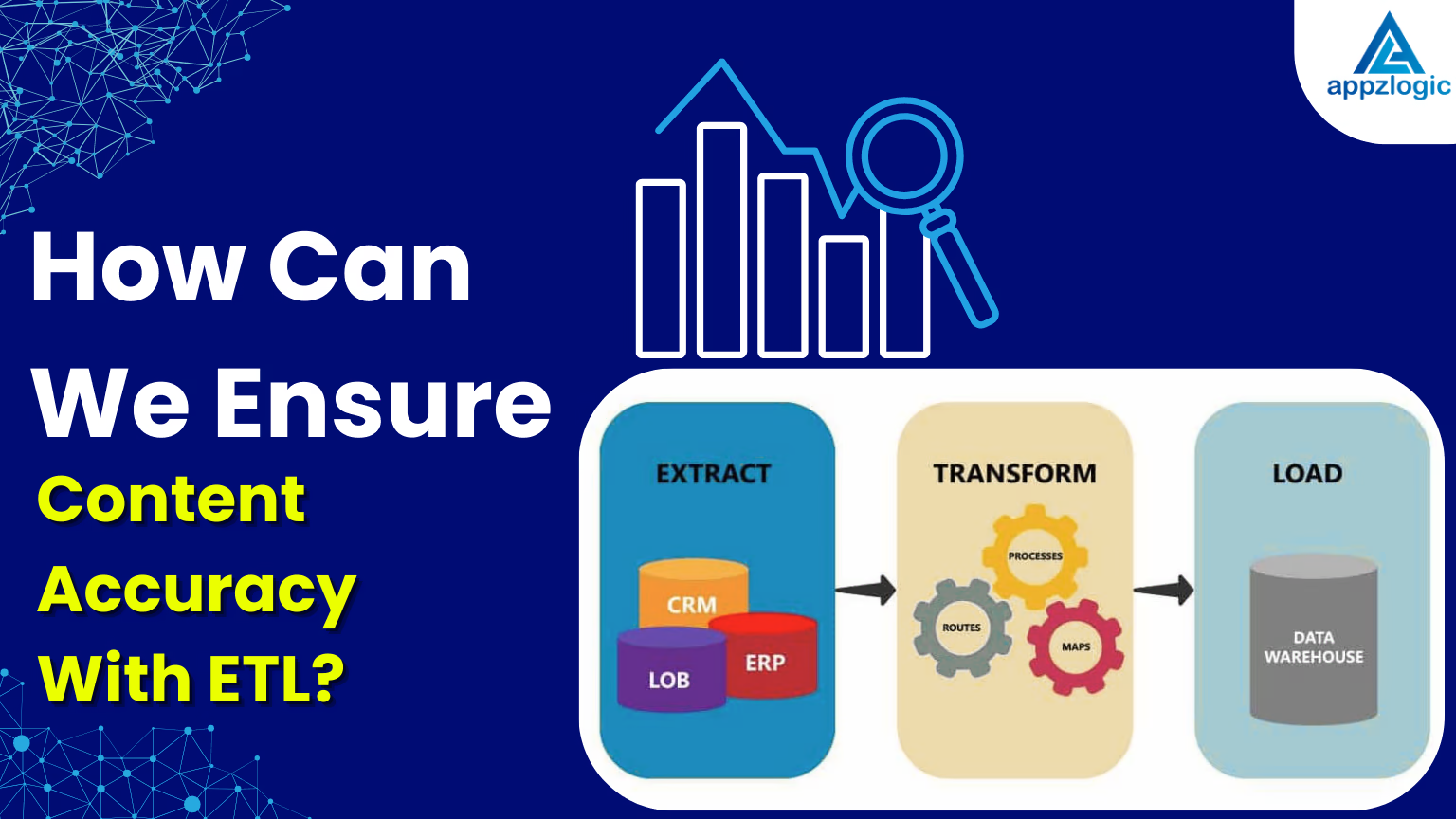
Automating data collection, transformation, and storage reduces manual effort, minimizes errors, and optimizes resource utilization. Cloud-based data solutions offer cost-effective scalability, allowing businesses to pay only for what they use.
3. Enhanced Customer Experience
With a well-structured data pipeline, small businesses can analyze customer behavior, preferences, and feedback. This enables them to personalize offerings, improve customer engagement, and boost retention rates.
4. Improved Compliance and Security
As data privacy regulations evolve small businesses must ensure data security and compliance. Modern data engineering tools include built-in governance features, helping businesses adhere to regulations like GDPR and HIPAA while securing sensitive customer information.
Conclusion
As data increasingly drives business strategies, it is essential to stay ahead of emerging trends in data engineering. The industry is rapidly advancing towards automation, real-time analytics, and the development of secure, scalable architectures. By embracing these innovations, businesses can unlock new opportunities, optimize decision-making, and maintain a competitive edge in the evolving digital landscape of 2025.
At Appzlogic, we offer advanced Data Engineering Solutions tailored to meet your business needs. Contact us today to learn how we can help you leverage data to fuel your growth.
Frequently Asked Questions
Data Engineering involves constructing systems for aggregating, storing, and analyzing large datasets.
AI helps automate processes like data integration, cleansing, and pipeline optimization, improving efficiency and reducing errors.
Data Engineering helps small businesses to streamline operations, make data-driven decisions, and ensure security regulations.
Popular tools include Apache Airflow, dbt, AWS Glue, Monte Carlo, Great Expectations, and MLOps platforms like MLflow and Vertex AI for enhanced data processing and automation.
Data privacy regulations, like GDPR and CCPA, require businesses to secure sensitive data and ensure compliance.