best staff augmentation services for it startups

Best Nearshore Staff Augmentation for IT Startups

Building the right technology team is one of the toughest challenges IT startups faces as they scale. Most of the startups begin with a strong idea and clear intentions but reshaping that idea into a reliable product requires much more than passion. It holds on to professional developers, testers, and engineers who meet the timelines, provide product quality, and develop user confidence. For startups that want to move fast without compromising accuracy, investing early in best quality assurance automation and strong technical talent becomes essential. 

Appointing regional often feels like the safest option, but it comes with its own limitations. Hiring cycles is long, costs is high, and access to suitable skills is less can slow progress at an important stage. That’s why many startups turn to nearshore staff augmentation. It gives a balanced way to quickly grow team, costs are controlled, and keep founders focus on building products rather than managing endless hiring processes.

Staff Augmentation for Best Automation Testing Services Company Support

On demand hiring is a model where startups extend their in-house teams by working with skilled professionals from nearby regions who operate in similar time zones. These professionals work as part of your internal team, following the same tools, workflows, and communication standards. The time zone alignment makes collaboration smoother and reduces delays in decision-making.

This approach is especially effective for startups building digital and mobile products that require constant coordination. Whether you are working with a top mobile application development company or strengthening your product with security expertise from a top cybersecurity services company, nearshore teams allow for faster feedback loops and better alignment across teams.

For startups prioritizing testing and stability, nearshore models also provide access to experienced QA engineers who understand automation, regression testing, and continuous integration practices. Many growing companies rely on nearshore talent aligned with a top AI based testing company to ensure product quality keeps pace with rapid development. By integrating nearshore professionals into the core app development and QA teams, startups gain flexibility without losing control. The result is faster execution, consistent quality, and a team structure that can adapt as the product and business grow.
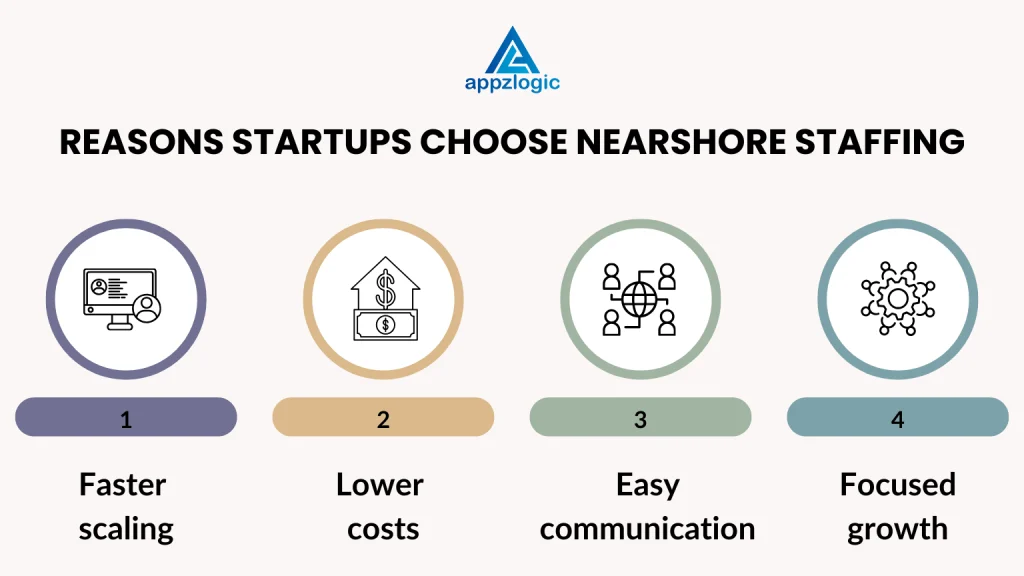
Why startups choose appzlogic staff

Why IT Startups Choose the Nearshore Model ?

IT startups operate in a fast environment where speed, quality, and cost matter equally. Traditional hiring slows progress, especially when startups need specialists in mobile app development, android software development, or cross platform app development. 

With nearshore staff augmentation, startups can quickly onboard experts for app development service, QA, cloud, or automation tasks. There is no need to wait months to hire or manage heavy onboarding costs. We stand as the top app development companies for the organizations who use nearshore models to stay flexible and competitive. This approach allows founders to focus on product vision while experienced professionals handle execution.

Flexibility That Supports Startup Growth

Flexibility is one of the strongest advantages of nearshore staff augmentation. Startup requirements change often based on funding, product stage, or customer feedback. Nearshore teams allow startups to scale resources up or down easily.

Whether you need developers to build mobile app features, testers for manual testing, or experts in QA automation, you can add talent when needed. This flexibility helps startups control costs while maintaining productivity. Instead of committing to permanent hires, startups bring in the right skills at the right time.

We Offer Cost-Effective Services Without Compromising Quality

Hiring locally can become costly very quickly, especially for startups trying to estimate the real cost to develop an app or the overall cost to build an app. Beyond salaries, some expenses are easy to overlook at the beginning, benefits, office setup, onboarding time, and ongoing training. Together, these costs can put pressure on early budgets and slow down progress. 

A more practical option for many startups is to work with teams that offer strong technical skills at a more manageable cost. Nearshore professionals often bring hands-on experience working with international products and teams. They are familiar with modern mobile app development software, common app building software, and agile ways of working. This makes collaboration smoother and reduces the learning curve.
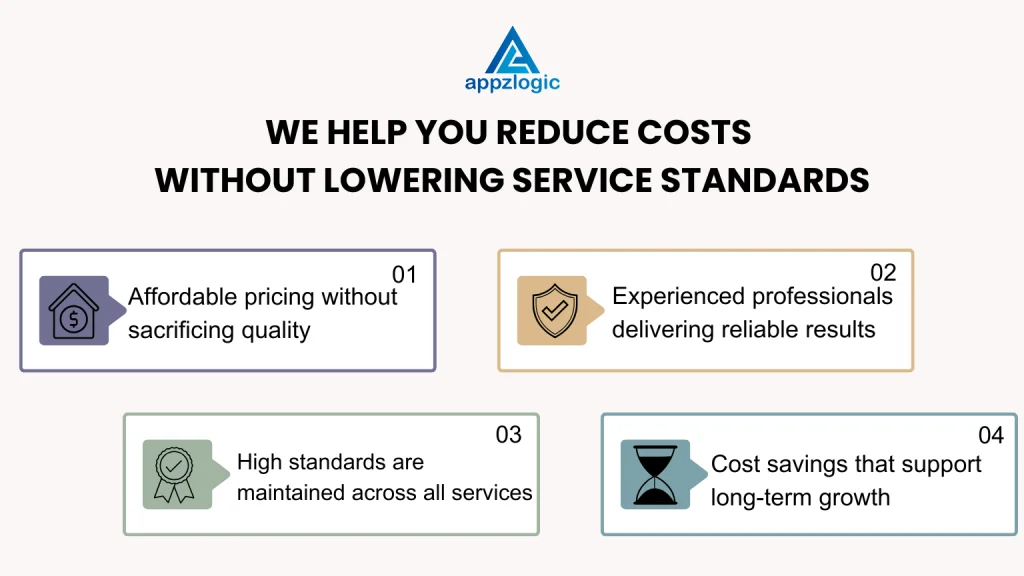
Appzlogic help businesses in cost reduction while stays on service standards

Access to Skilled and Specialized Talent

Hiring the right talent is often difficult for startups, especially when technology keeps changing. Finding experienced professionals for Android app development, React Native app development, or native app development can take time and effort. Nearshore staff augmentation helps startups reach a wider talent pool without long recruitment cycles.

With nearshore teams, startups can work with professionals who have hands-on experience in app development software, proven app development platforms, and modern technologies. This makes it easier to build reliable and well-designed applications without compromising quality.

Better Communication and Real-Time Collaboration

Clear communication plays a key role in successful product development. Delays, long response times, or unclear discussions can slow progress and affect results. Nearshore teams operate in similar time zones, allowing teams to work together in real time.

Daily stand-ups, sprint planning, and reviews happen smoothly without waiting for overlaps. This leads to faster feedback, better coordination, and stronger alignment during phone app development. Nearshore professionals collaborate closely with internal teams, working with the same ownership and responsibility as in-house mobile application developers.

Faster Project Delivery and Time-to-Market

Speed is critical for startups. Early launches and quick updates based on user feedback can make a real difference. Nearshore staff augmentation allows teams to onboard faster and start contributing immediately.

Startups can move ahead with initiatives to create mobile apps or create Android apps without delays caused by lengthy hiring processes. With aligned working hours and direct communication, decisions are made faster. This helps shorten development timelines and supports faster market entry.

Improved Focus on Core Business Goals

Handling recruitment, payroll, and team scaling often takes valuable time away from strategic priorities. Startup leaders need to focus on product direction, partnerships, and customer growth. Nearshore staff augmentation reduces this operational load.

With experienced professionals managing application development tasks, internal teams can stay focused on building and expanding the business. This approach allows startups to operate with the strength of an established app development firm while keeping internal operations simple.

Strong Team Integration and Transparency

Nearshore professionals work as an extension of the in-house team. They follow the same processes, tools, and reporting methods, which creates transparency and trust. Regular updates, clear milestones, and open communication ensure full visibility throughout the project.

Whether the work involves hybrid app development, Android app development software, or testing activities such as automated website testing, startups remain fully informed and in control. This transparency is especially important when managing tight schedules and changing requirements.

Broader Access to Required Skills

As startups grow, their technical needs evolve. One stage may require frontend expertise, while another may need backend development, cloud support, or automation services. Nearshore staff augmentation makes it easy to access a wide range of skills under one model.

Startups can build flexible teams for app development services, automation, testing automation, and automated testing software without coordinating multiple vendors. This approach supports long-term growth while keeping team management simple and efficient.
Best nearshore offshore services

How Appzlogic Helps IT Startups Succeed?

We help IT startups build strong and scalable teams through nearshore staff augmentation. As an experienced app development company and mobile development company, we understand the unique challenges startups face. Appzlogic supports startups looking to compete with best mobile app developers and top app developers globally. We focus on clear communication, transparency, and long-term collaboration. 

Conclusion

Nearshore staff augmentation is a powerful solution for IT startups aiming to grow efficiently. It offers flexibility, cost control, skilled talent, and faster delivery without the complexity of traditional hiring. By partnering with the right app company and nearshore provider, startups can improve productivity, manage cost to create an app, and deliver high-quality products faster. If you are looking to strengthen your development capabilities and work with experienced mobile application development companies, nearshore staff augmentation is a smart step forward. 

Contact Appzlogic today to access skilled IT professionals who understand your vision and help you build with confidence.
Request a demo

The Influence of Futurism on the Evolution of Cloud Automation Testing

In Software Development, testing methodologies have undergone a remarkable transformation, largely driven by the advent of Cloud Testing and Automation. This metamorphosis has been greatly influenced by the principles of futurism, envisioning and implementing innovative approaches to meet the evolving demands of quality assurance in the digital age. Among these approaches, cloud automation testing stands out as […]

Finance processes involve numerous tasks, multiple approvals, and strict compliance requirements, making them inherently complex and time-consuming. Organizations need a way to ensure that workflows are consistent, efficient, and transparent across departments while reducing errors and delays. Camunda BPM offers a powerful solution by enabling businesses to design, automate, and manage workflows using BPMN business process model and notation. With Camunda, finance teams can visualize processes clearly, implement automated tasks, and integrate workflows seamlessly with existing systems, improving overall efficiency and accuracy. By providing a structured framework for managing transactions, compliance checks, customer interactions, and reporting, Camunda simplifies the execution of finance processes, ensuring operations remain reliable, accountable, and easy to monitor. What is Camunda BPM? Camunda BPM is an open-source BPM platform built to execute and automate workflows created with BPMN. It enables organizations to design processes clearly, automate repetitive tasks, and manage complex workflows efficiently. Unlike traditional systems, Camunda offers flexibility, allowing businesses to adapt processes as their needs evolve without being tied to proprietary solutions. The platform is especially valuable for financial institutions because it supports critical operations such as compliance workflows, transaction monitoring, customer support processes, and regulatory reporting. Its seamless integration with existing systems through the Camunda API ensures that workflows operate smoothly across different departments and applications. By using Camunda BPM, organizations gain better control, transparency, and efficiency in their business processes, while also reducing risks and ensuring consistent performance across all operations. What is a BPMN Diagram? A BPMN diagram is the visual output of business process modeling. It shows tasks, events, and BPMN gateways that represent decision points in a process. For finance processes, these diagrams can illustrate how a loan request moves from submission to approval or rejection. Using a BPM platform like Camunda, financial organizations can move from static diagrams to executable workflows that directly integrate with systems and applications. What is BPMN in Business Analysis? Business analysts use BPMN because it provides a shared language for finance teams and IT departments, reducing miscommunication and ensuring everyone understands the same workflow. BPMN diagrams visually represent processes in a structured way, showing tasks, events, and decision points clearly. This makes it easier to identify inefficiencies, enforce compliance requirements, and uncover opportunities for automation using BPM automation tools. Beyond mapping processes, BPMN helps finance teams document workflows for audits, training, and continuous improvement. Analysts can track how tasks are performed, highlight repetitive steps that could be automated, and ensure that critical controls are in place. By using BPMN, organizations can align operational execution with strategic goals, monitor performance, and quickly adapt workflows as regulations or business priorities change. This approach supports transparency, accountability, and efficiency across all finance processes, helping teams deliver consistent results. Camunda Modeler The Camunda Modeler is a desktop application that allows users to design workflows using BPMN 2.0. When finance teams ask how to use Camunda Modeler, the answer is simple: it offers a drag-and-drop interface where you can design processes with tasks, events, and gateways.For instance, a financial compliance officer can use Camunda Modeler to build a process diagram for anti-money laundering checks. Once designed, the workflow can be deployed into the Camunda BPM engine, ensuring the process runs automatically. BPM Automation Tools in Finance Financial services require reliable BPM automation tools to handle high volumes of repetitive tasks. Camunda’s workflow automation ensures processes like payment reconciliation or fraud detection run consistently and accurately. Unlike traditional tools, Camunda does not act as a black box. Teams can monitor workflows in real time, adjust business rules, and continuously improve their models. This transparency is especially valuable in regulated industries where auditability is crucial. Camunda Workflow for Finance The Camunda workflow engine is the heart of execution. Once a business process model is created in the Modeler, the workflow engine ensures tasks are executed in order, data is routed correctly, and escalations happen on time. Camunda workflow is widely applied in loan application approvals, fraud detection checks, regulatory compliance reporting, and customer onboarding verification. With BPMN gateways, workflows can branch into different paths based on conditions, such as risk level or credit score. Camunda API for Integration One of the most powerful aspects of Camunda is its API design, which ensures that organizations can seamlessly connect their workflows with existing systems and applications. The Camunda API makes it possible for financial institutions to bring together multiple platforms, ranging from customer management systems and payment gateways to compliance and reporting solutions, into a single, unified process. This level of connectivity ensures that data moves smoothly across different departments, reducing silos and enhancing collaboration. We also use the Camunda API to help financial organizations to build integrated environments where workflows are not limited to a single tool but interact effortlessly with core banking platforms, regulatory systems, and enterprise applications. This approach provides finance teams with greater flexibility, visibility, and control, ensuring that their operations remain accurate. Business Process Modeling and Compliance Financial institutions operate under strict regulations, and ensuring compliance is a critical part of every workflow. Through business process modeling, organizations can embed compliance checks directly into their processes, making them an integral part of day-to-day operations rather than separate tasks. Using BPMN 2.0, rules and regulations are represented clearly and become part of the executable workflow, which ensures that every step follows established guidelines. This approach not only helps teams maintain accuracy and consistency but also provides transparency, making it easier to track processes and demonstrate compliance during audits. By integrating compliance into the workflow itself, financial organizations reduce the risk of errors or oversights, improve accountability, and create a system where regulatory requirements are consistently met across all operations. Camunda Enterprise Pricing When organizations consider adopting Camunda at an enterprise level, understanding Camunda enterprise pricing becomes important. While the open-source version provides robust workflow automation, the enterprise edition adds advanced capabilities such as dedicated support, enhanced monitoring tools, and greater scalability for large-scale operations. For financial institutions with high transaction volumes, complex compliance requirements, and critical regulatory obligations, the enterprise edition ensures that workflows remain reliable, secure, and efficient. By choosing enterprise features, organizations can manage processes confidently and maintain stability across all finance operations. Advantages of Camunda BPM Platform in Finance The BPM platform provided by Camunda offers multiple advantages for finance. Using business process model and notation, workflows become standardized across teams, ensuring clarity and consistency. The platform also provides transparency because workflows can be monitored in real time. Its flexibility is a major benefit as well, since through the Camunda API it integrates smoothly with core banking and compliance systems. Efficiency is improved as automated workflows reduce manual errors and delays, and scalability ensures that Camunda can serve both small financial teams and global banking organizations. How Finance Teams Use Camunda? Finance teams apply Camunda in multiple ways. Transaction approvals are automated with BPMN gateways, customer onboarding processes are enhanced through automated KYC checks, and compliance monitoring is handled by rule-based workflows.By combining business process modeling with automation, Camunda helps finance teams reduce costs while improving customer experiences. Conclusion Camunda BPM offers financial institutions a practical and efficient way to manage complex workflows, enforce compliance, and automate critical tasks. By using BPMN 2.0, organizations can clearly visualize processes, integrate systems through the Camunda API, and ensure that operations run smoothly and reliably. With tools like Camunda Modeler and BPM automation tools, finance teams gain transparency, control, and the ability to continuously improve workflows. At Appzlogic, we support organizations in including these capabilities and helping teams to implement Camunda effectively and ensuring that finance processes are not only automated but also aligned with operational and compliance requirements.

How Does Camunda Make BPMN Easier for Finance Processes?

Finance processes involve numerous tasks, multiple approvals, and strict compliance requirements, making them inherently complex and time-consuming. Organizations need a way to ensure that workflows are consistent, efficient, and transparent across departments while reducing errors and delays. Camunda BPM offers a powerful solution by enabling businesses to design, automate, and manage workflows using BPMN business […]

DeepSeek R1 and ChatGPT: A Comparison of AI Performance and Use Cases

Artificial Intelligence (AI) has evolved significantly, with chatbots and language models becoming essential tools in various industries. Two notable contenders, DeepSeek and ChatGPT, have emerged as powerful AI models, influencing how people engage with technology. This article compares their capabilities, accuracy, user experience, and industry impact. Open-Source AI Chatbot Open-source AI chatbots have gained eyeballs […]